
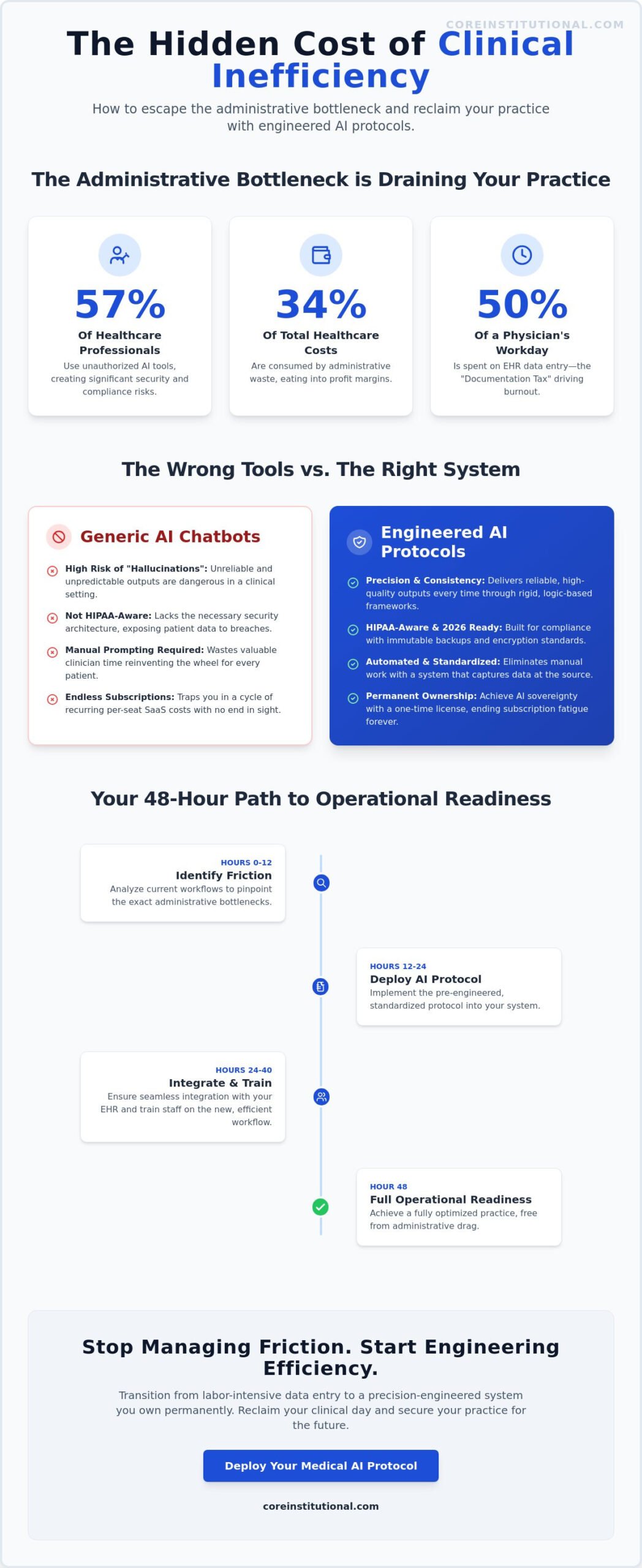
57% of healthcare professionals currently use unauthorized AI tools to escape the administrative waste that consumes up to 34% of total healthcare costs. This isn’t just a security risk; it’s a symptom of a broken system. You didn’t go to medical school to spend your life trapped in an EHR. You know that administrative bloat is eating your profit margins and creating unnecessary friction. Medical practice workflow optimization shouldn’t be a six-month software implementation or another monthly subscription. It’s an engineering problem.
We understand the pressure. Between the 2026 HIPAA Security Rule updates requiring immutable backups and evolving regulatory requirements, the regulatory landscape is shifting. You need clinical efficiency without the bloat. Fast implementation. Proven results. This article demonstrates how to eliminate administrative bottlenecks and achieve operational readiness using the Medical AI Protocol in under 48 hours. You’ll learn the exact steps to reduce documentation time by 50% while maintaining HIPAA-aware automation. We’re moving beyond generic prompts to engineered systems you own permanently.
Key Takeaways
- Transition from labor-intensive EHR data entry to precision-engineered systems that reclaim up to 50% of your clinical day.
- Achieve comprehensive medical practice workflow optimization by implementing standardized AI protocols rather than relying on inconsistent manual scribes.
- Eliminate “subscription fatigue” by securing permanent digital product licensing, ensuring AI sovereignty without recurring per-seat SaaS costs.
- Deploy HIPAA-aware automation that meets the 2026 security standards for immutable backups and encryption while protecting patient privacy.
- Follow a structured 48-hour roadmap to identify administrative friction and achieve full operational readiness with the purpose-built Medical AI Protocol.
The Administrative Bottleneck: Why Traditional Medical Practice Workflow Optimization Fails
Modern medicine suffers from a structural flaw. Administrative tasks now consume between 25% and 34% of total healthcare costs in the United States. Physicians spend 50% of their working hours on EHR data entry. This is a failure of system design. Traditional medical practice workflow optimization attempts usually involve adding more human staff. This is a mistake. Hiring scribes or administrative assistants often increases management overhead without solving the root cause. You end up managing the manager. It’s inefficient. It’s expensive. It’s unsustainable.
To better understand the mechanics of this operational friction, watch this helpful video:
Your EHR is a database. It’s built for billing and storage, not for clinical speed. It lacks the logic of a structured Clinical Pathway, which is necessary for high-volume efficiency. Most optimization strategies ignore the compliance barrier. They fail to account for the 2026 HIPAA Security Rule updates that mandate immutable backups and multi-factor authentication as required standards. Standard software isn’t engineered for this level of regulatory precision. It’s a bolt-on solution to a foundational problem.
The Physician Documentation Tax
Documentation is no longer a task; it’s a tax. Physicians lose hours every night to “pajama time” data entry. The Documentation Tax is the primary driver of clinical burnout. It turns clinicians into data clerks. This isn’t just an inconvenience. It’s a drain on practice margins. In 2025, 40% of medical groups reported productivity levels below expectations. The cause is clear: administrative bloat. You need a system that captures data at the source without manual intervention.
Why Generic AI Chatbots Are Not the Answer
Desperation leads to risk. 57% of healthcare professionals now use unauthorized AI tools. Generic chatbots aren’t clinical tools. They “hallucinate” facts and lack HIPAA-aware security. Manual prompt engineering is a waste of your time. It requires you to reinvent the wheel for every patient encounter. Without a standardized protocol, you risk violating the 2026 Texas AI disclosure laws or Illinois mental health oversight requirements. You need an engineered system, not a digital toy. Precision matters. Compliance is non-negotiable.
Engineering Efficiency: Transitioning from Generic Prompts to Standardized AI Protocols
Generic prompts are a liability in a clinical setting. They lack consistency. They fail under pressure. High-stakes medicine requires more than a digital assistant; it requires an engineered system. This is the shift from consumer-grade tools to Institutional AI. While 57% of healthcare professionals admit to using unauthorized AI, most are merely “chatting” with a machine. True medical practice workflow optimization requires the implementation of standardized AI protocols. These are rigid, logic-based frameworks designed to deliver the same high-quality output every time. No hallucinations. No guesswork.
The architecture of a protocol is fundamentally different from a chatbot. A chatbot is persuasive; a protocol is precise. It utilizes logic gates to filter patient data, ensuring that every assessment follows a specific clinical path. This is precision engineering for the front office and the exam room. It replaces the “bolt-on” software model with a unified system. You don’t need another subscription. You need a tool you own. For those ready to transition, the Medical AI Protocol provides the necessary framework for immediate operational readiness.
The Anatomy of a Medical AI Protocol
A functional protocol starts with logic-based inputs. It doesn’t ask the AI to “write a note.” Instead, it provides a structured assessment framework for patient history and clinical findings. The system processes these inputs through pre-defined rules. The output maps directly to your medical records, ensuring every note is HIPAA-compliant and audit-ready. This level of medical practice workflow optimization ensures consistency across multi-location practices. Every clinician follows the same high-standard framework. It eliminates the variance that leads to coding errors and billing delays.
Compliance-Aware Engineering
Regulations have evolved. As of March 2026, the HHS considers multi-factor authentication and immutable backups to be required standards, not options. This is where compliance-aware AI becomes essential. These systems are engineered with regulatory proofing in the foundation. Unlike generic tools, protocol systems maintain a clinical audit trail automatically. They don’t just process data; they protect it. By building compliance into the workflow, you remove the burden of manual oversight. It’s a “one-and-done” philosophy that secures your practice against the fragmented regulatory landscape of 2026. You own the system. You control the data. You eliminate the risk.
The Economic Framework: Comparing One-Time AI Licensing to SaaS Subscriptions
Software as a Service (SaaS) is a drain on clinical margins. Most medical groups treat technology as a perpetual line item. This is a mistake. Professional medical practice workflow optimization requires a transition from “forever rent” to permanent ownership. When you rely on per-seat subscriptions, your operational costs scale with your growth. You’re penalized for expanding. Digital product licensing reverses this trend. It allows you to invest once and own the system forever. No renewals. No price hikes. No hidden fees.
The financial reality of third-party AI is stark. As of January 2026, industry data suggests practices should budget between 15% and 20% of the initial purchase price just for annual maintenance and support contracts. SaaS vendors often compound this with annual price increases that exceed inflation. This creates a cycle of dependency. One-time licensing fees transform software from a recurring operational liability into a predictable capital asset. This is the difference between renting your tools and owning the factory.
ROI analysis favors the ownership model within the first 18 to 24 months. While a SaaS commitment may seem cheaper on day one, the cumulative cost over a 5-year period is often three times higher than a one-time protocol license. Engineered protocols eliminate the need for ongoing technical support. They’re no-code systems designed for immediate deployment. You don’t need a developer on retainer. You need a system that works from the moment of secure digital delivery. Fast implementation. Proven results.
The Hidden Costs of Medical SaaS
Price hikes are only one part of the problem. Data lock-in is the silent killer of clinical efficiency. When your workflow logic resides in a vendor’s cloud, you lose your systems the moment you stop paying. This creates an administrative burden of managing multiple vendor relationships and billing cycles. Licensed protocols provide a stable financial foundation. One-time licensing fees allow for a predictable CAPEX expenditure that simplifies your balance sheet and protects your long-term profit margins.
Achieving True AI Sovereignty
Owning your workflow logic is a critical component of practice valuation. If you intend to sell your practice, proprietary systems are a tangible asset. Relying on generic SaaS tools makes your operation replaceable. AI sovereignty ensures that your medical practice workflow optimization is localized and secure. It reduces the technical debt associated with legacy EHR integrations. By implementing the Medical AI Protocol, you secure your operational future. You own the logic. You control the data. You eliminate the vendor risk.
Implementation Roadmap: Optimizing Your Practice Workflow in Under 48 Hours
Most consultants treat medical practice workflow optimization as a “continuous journey” that lasts months. We don’t. Operational readiness is an engineering milestone, not a vague goal. By utilizing standardized protocols, you can overhaul your clinical efficiency in exactly 48 hours. This rapid deployment model eliminates the traditional “trial and error” phase. You move directly from identifying friction to executing a proven system. No technical support required. No custom coding. Just immediate results.
The roadmap follows a strict four-phase progression. Phases 1 and 2 occur within the first eight hours. You begin by identifying specific administrative friction points, such as the 50% of the day currently lost to EHR data entry. By hour eight, you’ve selected your protocol and received secure digital delivery to your inbox. This isn’t a software installation; it’s the acquisition of a pre-engineered workflow engine. It’s built to function from the moment of arrival.
Phases 3 and 4 focus on team onboarding and full EHR integration. Between hours 24 and 48, your practice transitions to full operational status. The system is tested against your current clinical pathways for precision and accuracy. Because the protocol is purpose-built for the medical industry, it aligns with existing billing codes and documentation standards. You aren’t changing how you practice medicine; you’re changing how you document it. Secure your Medical AI Protocol today to begin the 48-hour countdown.
Rapid Deployment Framework
Technical support is often a bottleneck. Our framework bypasses this by utilizing no-code systems. You don’t need an IT department to implement HIPAA compliant AI workflows for medical practices. We map these protocols directly to your current EHR logic. This ensures that the transition is frictionless. Testing protocols verify clinical accuracy in real-time, ensuring that every output meets the rigorous 2026 regulatory standards for patient care and data security. It’s precision by design.
Onboarding Your Clinical Team
Physicians don’t want to learn new technology. They want to see patients. We focus onboarding on results rather than software mechanics. Staff resistance evaporates when you provide immediate evidence of time-savings. When a clinician sees their documentation time drop by 50% in the first shift, adoption is guaranteed. We establish a 24-hour feedback loop during the initial rollout. This allows for rapid protocol refinement based on specific practice nuances. It’s a “one-and-done” philosophy that respects your time and your team’s expertise. Fast implementation. Proven results. Permanent ownership.
The Medical AI Protocol: Precision Engineered for Clinical Operational Readiness
The Medical AI Protocol isn’t a suggestion. It’s a standardized system designed for the rigors of modern medicine. Most medical practice workflow optimization attempts fail because they lack a rigid framework. They rely on “best guesses” or generic AI tools that don’t understand the 2026 HIPAA Security Rule updates. Our protocol is different. It’s engineered specifically for US medical compliance. It handles the logic of clinical assessments while maintaining an immutable audit trail. This is the “One-and-Done” philosophy. You implement the system once. You own the logic forever. No renewals. No subscriptions.
Operational readiness means your practice functions at peak capacity without administrative friction. You’ve seen the data. Administrative waste consumes up to 34% of healthcare costs. The Medical AI Protocol recovers that lost margin. It turns your documentation process into a high-speed clinical asset. It’s purpose-built for practitioners who don’t have time for trial and error. You move from a state of documentation backlog to total operational clarity. The system is delivered instantly to your inbox. You start today. You’re operational by the weekend.
Built for High-Stakes Practitioners
Generic prompt libraries fail because they’re inconsistent. They produce different results for the same input. Protocols succeed through rigid logic gates. This ensures that every clinical note and assessment meets your exact standards. Whether you’re a solo practitioner or managing a multi-location system, the implementation is the same. Fast. Secure. Professional. The Medical AI Protocol is a clinical asset, not a utility expense. It increases the valuation of your practice by securing your workflow logic in a format you own permanently.
Your Path to Operational Readiness
You can move from administrative bloat to clinical precision in 48 hours. The transformation is permanent. The 2026 regulatory landscape requires more than simple automation. It requires a system that respects the patient’s Right of Access and the 10-15 business day fulfillment targets. It requires compliance with state-level AI disclosure laws in Texas and mental health oversight in Illinois. We’ve done the engineering so you don’t have to. The final step is simple. Move beyond the “forever rent” model of SaaS. Secure your protocol license at the Core Institutional homepage and reclaim your clinical day.
Achieve Operational Readiness Today
The shift from administrative waste to clinical precision is an engineering milestone. You’ve identified the tax that consumes 34% of healthcare costs and recognized that the “forever rent” model of SaaS is a drain on your practice’s valuation. Permanent ownership of your workflow logic is the only way to secure your operational future. By choosing a standardized protocol over generic prompts, you ensure your practice meets the 2026 HIPAA Security Rule standards for encryption and data integrity.
This is the definitive path for medical practice workflow optimization. Our HIPAA-aware engineering eliminates the need for technical support or custom development. You get a purpose-built system delivered instantly. With a 24 to 48 hour implementation window and no monthly subscriptions, you can reclaim your clinical day immediately. Access The Medical AI Protocol and become operational in 48 hours. Stop the administrative bloat. Start practicing medicine with the precision you were trained for.
Frequently Asked Questions
How does medical practice workflow optimization reduce physician burnout?
Medical practice workflow optimization reduces burnout by eliminating the Documentation Tax that forces physicians to spend 50% of their day on EHR entry. Administrative tasks consume 25% to 34% of total healthcare costs. By automating these burdens, doctors reclaim their “pajama time.” This reduces the cognitive load of data clerking. Physicians return to patient care rather than digital data entry.
Is The Medical AI Protocol HIPAA-compliant?
Yes, it is engineered to be HIPAA-aware and meets the 2026 Security Rule requirements. These standards now mandate multi-factor authentication, strong encryption, and immutable backups as required safeguards. Our protocols ensure that patient data is handled within a secure, logic-based framework. We provide the necessary architecture to maintain clinical audit trails without manual oversight. It’s security by design.
How long does it take to implement AI protocols in a medical office?
Full implementation is achieved in under 48 hours. Our rapid deployment framework bypasses the months-long timelines typical of hospital-grade software. You receive secure digital delivery within 8 hours. Onboarding and workflow testing occur within the first 24 hours. By the end of day two, your practice is fully operational with clinical precision. Fast implementation. Proven results. No downtime.
What is the difference between an AI scribe and an AI protocol?
An AI scribe is a passive recording tool; an AI protocol is a logic-based engineering system. Scribes often require manual review and lack standardized clinical logic. Protocols use rigid logic gates to ensure consistent, compliant outputs every time. This provides medical practice workflow optimization that is replicable across multi-location practices. It’s a structured system rather than a digital assistant.
Do I need technical support to install these AI workflows?
No technical support is required for setup or maintenance. These are no-code systems designed for immediate use by clinical staff. We eliminate the “Technical Support” bottleneck by providing a “one-and-done” digital product. You don’t need a developer or an IT department to achieve operational readiness. The logic is built-in and ready for deployment. Implement once. Own forever.
Can I use these protocols with my existing EHR system?
Yes, the protocols are engineered to map directly to standard EHR logic. They function as a workflow engine that sits atop your existing database. This reduces the technical debt of legacy system integrations. You maintain your current patient records while upgrading the speed and accuracy of the data entry process. It’s a frictionless integration for modern practices. No custom software development needed.
Why is a one-time license better than a monthly AI subscription?
One-time licensing provides permanent AI sovereignty and eliminates “forever rent” costs. SaaS vendors often charge 15% to 20% of the purchase price annually for support, plus recurring per-seat fees. Licensing turns technology into a predictable capital asset rather than a growing operational liability. You own the system logic forever. There are no renewals and no price hikes. Digital product licensing ensures long-term profit protection.