
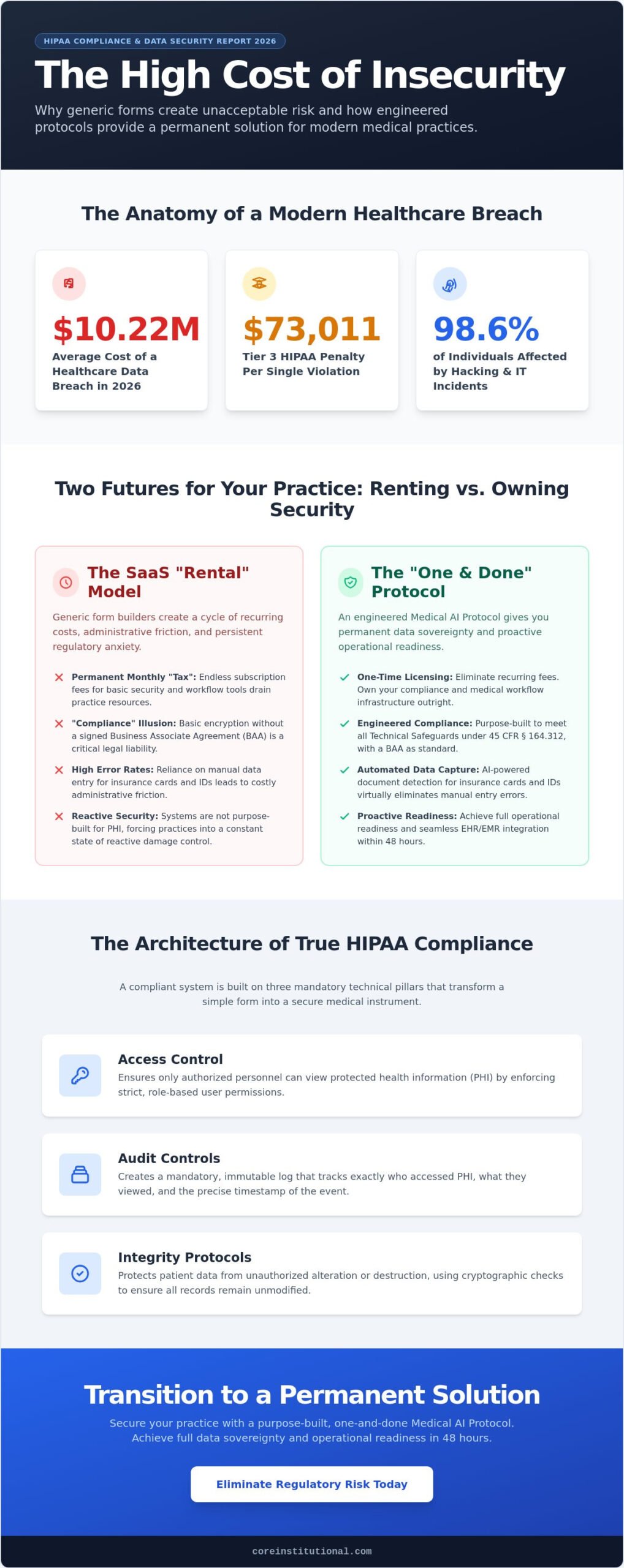
In 2026, the average cost of a healthcare data breach has climbed to $10.22 million. For most practices, the vulnerability starts at the front door. Implementing HIPAA compliant patient intake forms isn’t just about digitizing paperwork. It’s about engineering a secure data perimeter. You likely feel the weight of regulatory anxiety every time a new record is created. Manual entry errors and slow onboarding don’t just hurt your efficiency; they invite Tier 3 penalties that now reach $73,011 per violation.
We agree that the current SaaS model is an unnecessary drain on your practice resources. You shouldn’t have to pay a permanent monthly tax for basic security. This article shows you how to eliminate regulatory risk and administrative friction using engineered, HIPAA-aware systems. You’ll learn how to achieve full data sovereignty and operational readiness within 48 hours. We’ll preview the transition from generic form builders to a purpose-built Medical AI Protocol that offers a one-and-done compliance solution. No subscriptions. No renewals. Fast implementation.
Key Takeaways
- Identify the specific technical safeguards under 45 CFR § 164.312 required to bridge the gap between simple digital forms and true regulatory compliance.
- Learn to engineer HIPAA compliant patient intake forms that utilize automated document detection for insurance cards, significantly reducing manual entry errors.
- Evaluate the economic impact of “renting” your medical workflows through SaaS versus owning your protocols for permanent data sovereignty.
- Audit existing intake bottlenecks to create a streamlined data flow that integrates directly with your EHR or EMR system within 48 hours.
- Transition to the Medical AI Protocol to secure a purpose-built, one-and-done solution engineered for high-stakes clinical precision.
What Defines a HIPAA Compliant Patient Intake Form in 2026?
Modern medical practices cannot survive on “digital” alone. A 2026-standard for HIPAA compliant patient intake forms is a secure interface for PHI collection that meets all Technical Safeguards under 45 CFR § 164.312. It’s an engineered entry point. Simple encryption isn’t enough. You need a system that manages data transit and storage with clinical precision. In February 2026 alone, 63 large data breaches were reported to the HHS. These incidents often stem from brittle, un-engineered systems that lack the necessary rigor for high-stakes medical environments.
Many providers mistakenly believe that any encrypted form is compliant. This is false. True compliance requires a legal and technical framework that aligns with the Health Insurance Portability and Accountability Act (HIPAA). Without a signed Business Associate Agreement (BAA), your digital form is a liability, not an asset. End-to-end encryption using AES-256 standards is the baseline, but the BAA is the non-negotiable legal foundation. It ensures the vendor accepts shared responsibility for the protection of your patient data.
To better understand this concept, watch this helpful video:
The Core Technical Requirements
Compliance is built on three engineered pillars. Access control ensures only authorized personnel view sensitive intake data. Your system must restrict PHI based on specific user roles. Audit controls are also mandatory. You must track who accessed what PHI and the exact timestamp of the event. Finally, integrity protocols protect data from unauthorized alteration during the intake process. If a record is modified, the system must flag it. These protocols transform a simple form into a sophisticated piece of medical machinery.
HIPAA-Aware vs. HIPAA-Compliant
Generic form builders fail the clinical rigor test. They lack the engineered DNA required for modern practices. Choosing HIPAA compliant patient intake forms means looking for a system that understands the data it handles. A HIPAA-aware system is a protocol that proactively prevents PHI exposure before it occurs. It doesn’t just store data; it protects your practice from human error. This distinction is the difference between reactive damage control and proactive operational readiness.
Engineered systems move beyond simple text fields. They utilize automated document detection for insurance cards and IDs. This reduces the primary cause of breaches: hacking and IT incidents, which accounted for 98.6% of affected individuals in early 2026. By implementing a purpose-built protocol, you eliminate the administrative friction that plagues generic software. You gain a one-and-done solution that secures your practice for the long term.
The Architecture of Secure Data Collection
Effective patient intake isn’t a design project. It’s a structural requirement. In 2026, HIPAA compliant patient intake forms must function as high-precision instruments. Most generic builders prioritize “simplicity” over structural integrity. We prioritize engineering. This architecture moves beyond basic text fields to include automated document detection. Your system should recognize an insurance card or government ID instantly. This eliminates the manual entry errors that compromise data. In February 2026, hacking and IT incidents accounted for 98.6% of individuals affected by breaches. A robust architecture is your first line of defense.
Engineered workflows utilize conditional logic to reduce patient friction. If a patient indicates they don’t have secondary insurance, the system should skip those fields entirely. It’s about efficiency and relevance. Furthermore, secure digital signatures are a mandatory component of this architecture. They must meet the legal standard for medical consent. This isn’t just a checkbox; it’s a protocol-driven validation of patient intent. If you’re ready to move past temporary fixes, consider how a purpose-built medical protocol can secure your practice.
Automating Patient Documentation
When your intake system is properly engineered, the data flows without friction. This information feeds directly into patient documentation automation. It’s about protocol-driven mapping. You don’t just collect data; you deploy it. This ensures consistency across the entire patient lifecycle, from the first click to the final EHR entry. Eliminating manual transcription isn’t just a convenience. It’s a risk mitigation strategy. One-time data entry reduces the $408 cost per stolen record associated with fragmented systems.
Security Protocols for PHI Transit
Security during transit is where many systems fail. We utilize a “Zero-Knowledge” architecture. The software provider should never have the keys to your data. Following the HIPAA Security Rule ensures that administrative, physical, and technical safeguards are locked. Every submission travels through a secure delivery mechanism directly to an encrypted inbox. This is how you protect the 9.6 million individuals whose PHI was compromised in early 2026. Protocol-based validation ensures every field meets clinical standards before it’s stored. It’s precise. It’s secure. It’s operational.
Economic Analysis: One-Time Licensing vs. SaaS Subscriptions
Renting your medical workflows is a strategic error. In 2026, the SaaS model dominates the market for HIPAA compliant patient intake forms, with enterprise pricing often exceeding $300 per month. This creates a permanent monthly tax on your practice’s growth. High-stakes practitioners need a more efficient path. You need data sovereignty. Owning your protocol ensures that your patient data isn’t locked behind a vendor’s paywall. It’s about clinical precision and financial control. No subscriptions. No renewals.
Adhering to HIPAA Security Rule standards requires more than just a secure connection. It requires a system you control entirely. When you rent software, you’re at the mercy of the vendor’s security updates and inevitable price hikes. A one-time digital license removes this uncertainty. Engineered systems provide operational readiness within 24 to 48 hours. This rapid pace reflects a core value: your time is the most expensive asset in the clinic. Fast implementation. Proven results.
Calculating the ROI of Permanent AI Protocols
Look at the numbers. An enterprise SaaS subscription at $300 per month costs your practice $10,800 over three years. That’s a significant drain on resources for a generic tool that you never truly own. One-time licensing fees offer financial predictability that annual SaaS price hikes simply cannot match. Engineered “No-Support” systems are built for reliability. They don’t rely on billable hours or recurring revenue to survive. They’re designed to work from day one without trial and error.
Ownership and Regulatory Proof
Ownership simplifies the process of compliance-aware AI audits. When you own the protocol, you possess the full map of your data flow. This reduces vendor lock-in and platform dependency. In an environment where third-party vendors are involved in 34% of healthcare data breaches, minimizing external dependencies is a security imperative. You gain the peace of mind that comes with a permanent, secure implementation. It’s a strategic medical asset. It’s a one-and-done solution for serious professionals.
Transitioning to Engineered Intake Protocols
The transition from manual systems to engineered protocols is a clinical necessity. Paper forms and static PDFs are no longer viable in a landscape where the protected health information of 9.6 million individuals was compromised in early 2026. True HIPAA compliant patient intake forms require a structural shift. Start with a comprehensive audit. Identify every bottleneck in your current paper or PDF-based intake. Manual transcription is where errors live and where security fails. In 2026, the cost per stolen healthcare record is $408. This makes mapping patient data flow from entry to EHR/EMR integration a financial priority.
Staff training should focus on protocol-driven management rather than technical troubleshooting. Your team doesn’t have time for trial and error. They need a system that works from day one. Clinical precision requires a patient-first design that removes friction without lowering the security perimeter. When you eliminate redundant data entry, you eliminate the primary cause of administrative fatigue. Deploy the Medical AI Protocol to secure your practice and achieve full operational readiness immediately.
Phase 1: Workflow Mapping
Phase one involves identifying redundant questions in your current intake packet. Most practices find that 15% to 20% of their fields are unnecessary or repetitive. Streamlining the ‘Consent to Treat’ and ‘Privacy Policy’ signatures is critical. As of February 16, 2026, the Part 2 Final Rule requires updated Notice of Privacy Practices for entities maintaining substance use disorder records. Your mapping must account for these regulatory deadlines. Determine the optimal triggers for automated follow-ups to ensure no patient data is left unverified.
Phase 2: Implementation and Validation
Deployment occurs within a 48-hour operational window. This isn’t a months-long software development project. It’s a protocol implementation. Once live, conduct a compliance stress test on the new digital interface. You must verify that all automated outputs meet the rigorous standards defined by the HHS Office for Civil Rights. Validation ensures that the data perimeter is secure and that the system is functioning as a piece of high-precision medical machinery. Results are immediate. Risk is eliminated. Your practice is operational.
The Medical AI Protocol: A Permanent Solution for Modern Practices
Generic software platforms often over-complicate what should be a streamlined clinical process. While competitors focus on “patient engagement” suites that bundle unnecessary features, we prioritize the engineering of the data itself. Transitioning to HIPAA compliant patient intake forms shouldn’t require a permanent monthly tax or a complex IT department. It requires a protocol. The Medical AI Protocol is a purpose-built system designed for clinical precision. It’s not a subscription. It’s a strategic asset that you own entirely. Fast implementation. Proven results.
The 2026 regulatory landscape is unforgiving. With Tier 4 penalties for willful neglect now capped at $2,190,294 annually, the margin for error has vanished. Relying on “rented” workflows means your compliance is only as strong as your vendor’s latest update. We favor engineered protocols because they offer a one-and-done solution. You receive instant digital delivery of a system that’s already been stress-tested for the February 16, 2026, Part 2 Final Rule requirements. This is how serious professionals eliminate risk. No more monthly overhead. No more regulatory anxiety.
Engineered for Efficiency
We’ve removed the learning curve. The Medical AI Protocol is a “no-code” system, meaning you don’t need technical support or custom software development to become operational. It’s designed for both solo practitioners and multi-location clinics that require precision workflows. The system is delivered directly to your professional inbox. You aren’t logging into a third-party dashboard that tracks your every move. You’re deploying a secure, HIPAA-aware perimeter that you control. It’s efficient. It’s authoritative. It’s ready.
Taking the Next Step
Acquiring the protocol is a frictionless process designed to respect your time. Once you secure the license, you can move from a problem state to an operational state in as little as 24 hours. Our 48-hour promise ensures that even the most complex practices can overhaul their intake workflows without disrupting patient care. You don’t have time for trial and error or generic prompts. You need a system built for the specific legal constraints of the medical field. Secure your practice with The Medical AI Protocol today and claim full data sovereignty. One-time purchase. Zero monthly fees. Instant delivery.
Achieving Engineered Clinical Sovereignty
The transition to engineered intake is a strategic imperative. You’ve seen how “rented” SaaS workflows create permanent overhead and unnecessary risk. True data sovereignty requires owning your protocols. By implementing HIPAA compliant patient intake forms, you replace administrative friction with clinical precision. You eliminate the threat of Tier 4 penalties and the $10.22 million average cost of a breach. This is how you secure your practice perimeter for the long term.
The path forward is clinical. Not conceptual. We’ve removed the technical barriers. You don’t need a developer or a long-term contract. You need a system that works from the moment it hits your inbox. The Medical AI Protocol is a one-and-done solution for serious practitioners. It’s purpose-built for the 2026 regulatory environment. Fast implementation. Proven results.
Acquire The Medical AI Protocol and Secure Your Practice today. Our system is engineered for HIPAA precision and makes your practice operational in 24 to 48 hours. No monthly subscriptions. No renewals. Take control of your medical workflows and protect your patient data with confidence.
Frequently Asked Questions
What makes a patient intake form HIPAA compliant?
Compliance requires meeting technical safeguards under 45 CFR § 164.312, including access controls, audit logs, and integrity checks. It’s not just about encryption. You must have a signed Business Associate Agreement (BAA) with the vendor. In 2026, 98.6% of breaches involve IT incidents, making these structural layers mandatory for practice survival.
Can I use ChatGPT to create patient intake forms?
No, generic AI models lack the necessary BAA and structural safeguards to handle PHI legally. Using them for intake risks Tier 4 penalties, which carry an annual cap of $2,190,294 as of January 2026. You need an engineered protocol purpose-built for clinical data sovereignty rather than a general-purpose chatbot.
Do I need to sign a BAA for my online intake forms?
Yes, a signed Business Associate Agreement is a non-negotiable legal requirement for any third party handling PHI. Without it, you are in direct violation of federal law, regardless of the software’s encryption levels. In early 2026, third-party vendors were involved in 34% of all reported healthcare data breaches.
What is the difference between a form builder and a medical AI protocol?
A form builder is a generic tool for data collection; a medical AI protocol is an engineered system for clinical data management. Protocols prioritize data sovereignty and eliminate monthly SaaS overhead. They’re purpose-built to automate documentation and integrate with EHRs without the administrative friction of “rented” software.
How long does it take to implement a HIPAA compliant intake system?
Implementation of an engineered protocol occurs within a 24 to 48-hour window. This rapid pace is achieved because the system is “no-code” and requires no custom software development. It’s a one-and-done solution delivered directly to your professional inbox for immediate operational readiness. Fast implementation. Proven results.
Are there any one-time fee options for HIPAA compliant forms?
Yes, the Medical AI Protocol offers a one-time licensing model that explicitly rejects the SaaS subscription standard. While the market has standardized on monthly fees ranging from $79 to over $300, our protocol eliminates recurring costs. This provides financial predictability and permanent ownership of your medical workflows.
What happens if a patient’s data is breached during intake?
Breaches trigger mandatory reporting to the HHS and potential fines reaching $73,011 per violation for neglect. In 2026, the average cost per stolen healthcare record is $408. Utilizing HIPAA compliant patient intake forms within an engineered protocol minimizes this risk by securing the data perimeter from the point of entry.
How does AI improve the patient intake process?
AI improves intake by automating document detection and reducing manual entry errors that plague traditional workflows. It uses conditional logic to ask only relevant questions, speeding up patient onboarding. This transforms intake from a bottleneck into a high-precision data entry point for your entire practice.