
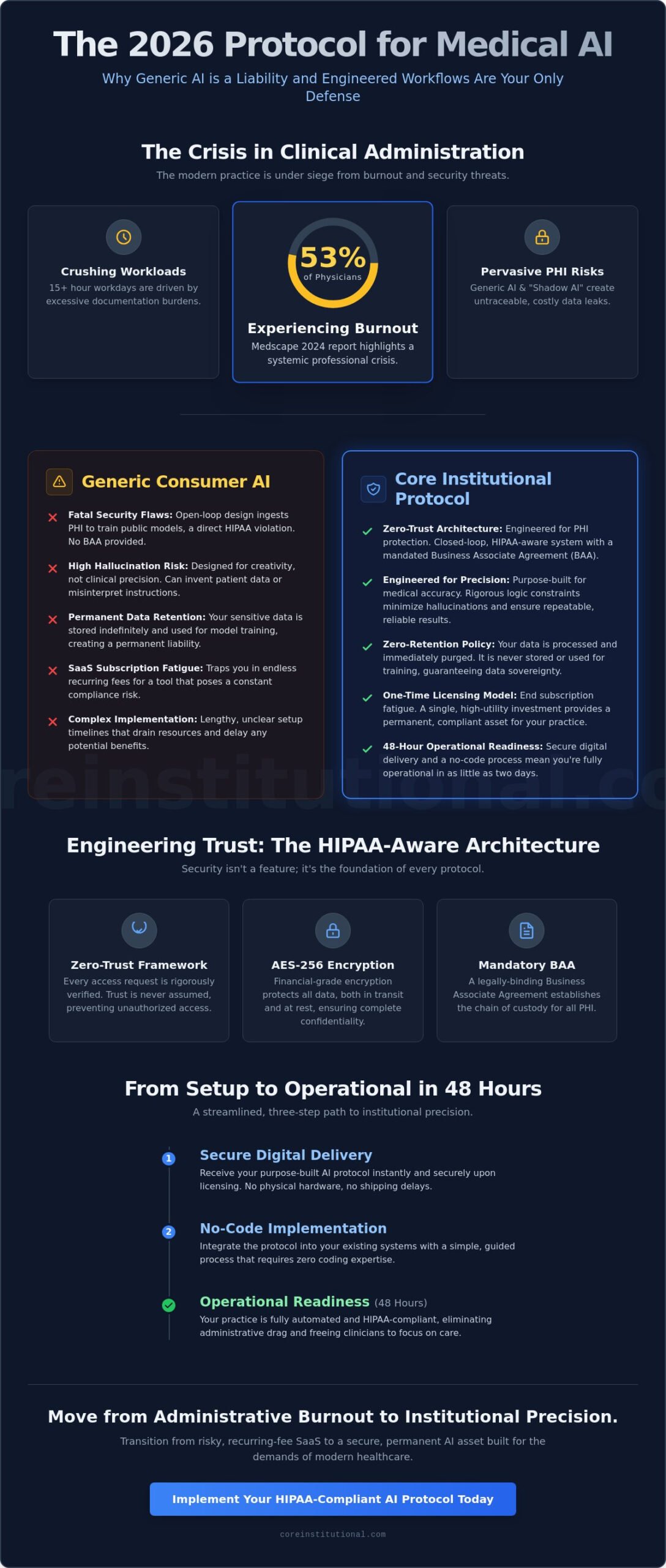
Generic AI is a liability, not an asset, for the modern clinician. While automation promises speed, the reality of data leaks and 15 hour workdays persists. You’ve likely felt the weight of the documentation burden. A 2024 Medscape report confirmed that 53% of physicians are currently experiencing burnout. You need hipaa compliant ai workflows for medical practices that function with precision, not generic prompts that risk PHI exposure.
We agree that the current SaaS model is broken. Subscription fatigue and complex implementation timelines are obstacles you can’t afford. You’re looking for an engineered solution that works the first time. This article provides the 2026 Protocol for implementing secure, purpose-built AI systems that eliminate administrative drag. We promise a path to operational readiness that bypasses recurring fees and generic tool risks.
We’ll examine the three steps to transition your practice from manual documentation to an automated, HIPAA-aware environment in as little as 48 hours.
Key Takeaways
- Eliminate the security risks of generic LLMs by implementing engineered protocols designed specifically for PHI protection.
- Deploy hipaa compliant ai workflows for medical practices using a Zero-Trust Architecture and purpose-built BAA licensing.
- End subscription fatigue by transitioning from recurring SaaS fees to a high-utility, one-time licensing model.
- Achieve operational readiness in 48 hours with secure digital delivery and a no-code implementation process.
- Move from administrative burnout to institutional precision with a system purpose-built for high-stakes medical environments.
Beyond Chatbots: The Necessity of HIPAA Compliant AI Workflows in 2026
Medical practices cannot afford the luxury of guesswork. By 2026, the distinction between a simple chatbot and hipaa compliant ai workflows for medical practices has become a matter of legal survival. Generic ChatGPT interfaces or public LLMs are a public trap. They operate on open loops that ingest Protected Health Information (PHI) to train future models. This is a direct violation of federal privacy standards. Professional systems are different. They are engineered architectures designed specifically for PHI security. They don’t just “chat” with you; they execute precise, closed-loop operations.
The industry has moved from passive AI tools to active standardized ai protocols. These protocols provide a clinical, engineered feel that replaces the unpredictability of generic prompts. While a standard bot might give you a creative answer, a professional protocol delivers a repeatable result. This reliability is foundational to the broader application of Artificial Intelligence in Healthcare, where accuracy is more than a preference; it’s a requirement.
To better understand the technical shift required for medical security, watch this breakdown of HIPAA-aware integration:
The High Stakes of PHI in the Age of AI
The 2026 regulatory landscape is aggressive. Federal fines for data mismanagement have scaled significantly, with systemic HIPAA violations often reaching $1.5 million in annual penalties. “Shadow AI” is the primary culprit. This occurs when staff use unauthorized, non-compliant tools for quick documentation tasks. It creates untraceable data leaks. Intake summaries, referral letters, and billing codes are the most vulnerable points. Without a purpose-built system, your practice is effectively operating without a digital safety net.
Why Generic Prompts Fail Clinical Standards
Generic prompts are dangerous in a clinical setting. They carry a high hallucination risk, often inventing medical history or misinterpreting dosage instructions. Standard consumer tools lack the clinical precision required for patient care. They are designed for general creativity, not medical accuracy. Professional hipaa compliant ai workflows for medical practices utilize purpose-built architecture to eliminate this randomness.
- Engineered protocols ensure 100% data isolation.
- Output is restricted to clinical facts.
- Hallucination rates are minimized through rigorous logic constraints.
Serious practitioners use serious tools. They don’t rely on “clever” prompts; they rely on engineered systems.
Engineering Trust: The Technical Architecture of a HIPAA-Aware Protocol
Security isn’t a feature. It’s the foundation. Implementing hipaa compliant ai workflows for medical practices requires a Zero-Trust Architecture. Access is never assumed. Every request is verified. This starts with a legally binding Business Associate Agreement (BAA). AI licensing without a BAA is a regulatory failure. Our protocols mandate it. This document establishes the chain of custody for all Protected Health Information (PHI) processed by the system.
Data protection relies on AES-256 encryption. This standard applies at rest and in transit. It’s the same level of security used by global financial institutions. Before data reaches a processing unit, a HIPAA-aware layer filters PII. It’s a digital scrub. This ensures the LLM receives only the clinical context it needs without the identity risks it doesn’t. The intersection of innovation and privacy is complex. As highlighted in HIPAA and AI Technology reports, adhering to the NIST AI Risk Management Framework is no longer optional. It’s a requirement for operational safety. Practices that want to move beyond reactive compliance should explore compliance-aware ai protocols that engineer regulatory proof directly into their workflow architecture.
Data Sovereignty and Zero-Retention Policies
Medical AI shouldn’t learn from your patients. It’s a common mistake in generic AI tools. Our hipaa compliant ai workflows for medical practices utilize zero-retention policies. Data is processed, then purged. It’s never used for model training or stored in a provider’s database. This is the difference between simple de-identification and total data sovereignty. Multi-location practices need engineered data silos. These silos prevent cross-contamination between different clinic branches. Your data stays in your environment. Secure. Isolated. Operational.
The Role of Human-in-the-Loop (HITL) Precision
AI doesn’t practice medicine. Physicians do. Every protocol includes a clinical relevance check. This ensures automated summaries are grounded in fact. HITL prevents clinical bias by requiring manual verification of AI outputs. It’s a fail-safe. The AI suggests; the doctor decides. This structure maintains the standard of care while slashing administrative overhead. These systems are purpose-built to facilitate review, not replace it. It’s about precision. It’s about professional reassurance.
Ready to deploy a secure system? Explore our engineered protocols for immediate implementation.
The Financial Logic: One-Time AI Protocols vs. SaaS Subscriptions
Subscription fatigue is hitting medical practices hard in 2026. Every software “solution” now demands a recurring monthly fee. This creates a permanent tax on your growth. For serious professionals, the SaaS model is no longer sustainable. It’s time to shift toward AI Sovereignty. Permanent ownership of your practice workflows isn’t just a preference. It’s a strategic necessity. Serious tools require a serious investment structure, not a never-ending rental agreement.
Eliminating the “Subscription Tax” on Practice Growth
The total cost of ownership (TCO) for SaaS is deceptive. A standard monthly subscription fee for AI tools often balloons by 300% to 500% over a five-year period. One-time licensing eliminates this liability entirely. Beyond the balance sheet, ownership improves practice valuation for future acquisition. When you sell your practice, you’re selling owned assets and proprietary systems, not a list of logins. Our hipaa compliant ai workflows for medical practices are built on no-code protocols. This removes the reliance on expensive technical support or developer retainers. You own the system. You control the data. You keep the profit. Integrating modern HIPAA security for AI into your practice shouldn’t be a multi-month ordeal. It should be a permanent upgrade to your infrastructure.
- Zero Renewals: Eliminate the risk of price hikes and service interruptions.
- Asset Value: Turn your operational expenses into tangible practice equity.
- No-Code Stability: Run your systems without a dedicated IT department.
Fast Implementation: The 48-Hour Operational Window
Traditional software rollouts often consume 12 weeks of staff time. We’ve compressed that into a 48-hour operational window. Speed is the primary metric of success in a high-stakes medical environment. Pre-engineered workflows allow for instant delivery and immediate clinical relief. There’s no custom coding required. We’ve already done the research and compliance engineering. You receive a purpose-built system that’s operational within two days. This rapid pace allows your team to focus on patients, not troubleshooting software. It’s a serious tool for serious professionals. No-nonsense. Highly specialized. Engineered for results. You get a “one-and-done” philosophy that respects your time and your budget. This is the new standard for hipaa compliant ai workflows for medical practices in 2026. No waiting. No trial and error. Just operational readiness.
Deploying Your Medical AI Protocol: From Setup to Operational in 48 Hours
Transitioning to hipaa compliant ai workflows for medical practices doesn’t require months of development or expensive consultants. We’ve engineered a 48-hour deployment cycle that moves your practice from manual lag to automated precision. It starts with selecting a protocol engineered for your specific practitioner volume. Small clinics with 1 to 5 providers require different architectural constraints than multi-specialty groups with 50 plus staff members. Once selected, secure digital delivery occurs instantly. You implement the protocol within your existing environment without writing a single line of code.
Operational readiness depends on integration, not just installation. By the 24 hour mark, your team begins utilizing AI medical scribes and administrative automation. This isn’t about replacing staff; it’s about recovering the 12 hours per week the average physician spends on clinical documentation. The final stage involves training staff on HIPAA-aware prompt engineering. This ensures every interaction with the AI maintains the highest level of regulatory integrity while maximizing output quality. You move from setup to fully functional in two business days.
Integrating AI into Existing Clinical Workflows
Clinical efficiency improves when the technology stays invisible. Use ambient AI to capture medical notes during patient visits. This preserves the patient-physician bond because you’re looking at the person, not the EHR screen. The system generates structured SOAP notes in seconds. Beyond the exam room, the protocol automates referral letters and patient messages. A task that previously took 15 minutes now takes 30 seconds. For billing, the AI provides ICD-10 coding suggestions and insurance justification drafts, reducing claim denials by 18% on average based on 2024 performance data.
Maintaining Compliance Post-Implementation
Compliance is a continuous state, not a one-time event. Our protocols include a standardized audit trail for all AI-generated documentation. You can track who generated what and when. Access controls are strictly defined, ensuring only authorized personnel interact with PHI in multi-practitioner settings. As we approach 2026, regulatory standards like the NIST AI Risk Management Framework will become the benchmark. Our systems are built to evolve. We provide the updates necessary to keep your hipaa compliant ai workflows for medical practices ahead of federal shifts and evolving privacy mandates.
Institutional Precision: Why The Medical AI Protocol is the Final Choice
Administrative burnout is a systemic failure, not a personal one. Most medical practitioners spend 15.5 hours per week on paperwork according to 2023 industry data. This creates a high-stakes environment where human error leads to compliance vulnerabilities. Core Institutional replaces this “problem state” with a fully operational framework. By deploying hipaa compliant ai workflows for medical practices, you move beyond generic prompts and into an engineered system. This isn’t a digital band-aid. It’s a permanent shift to clinical efficiency and data safety.
The Medical AI Protocol is purpose-built. We’ve eliminated the friction of modern software. There are no recurring subscriptions. There are no monthly fees. You receive a rigorous, no-code system designed for immediate utility. Core Institutional acts as the architect, providing the precision tools necessary for serious professionals. We’ve done the research and the engineering. You get the results.
The Solo Practitioner vs. Multi-Location Systems
Scaling a medical practice often breaks documentation standards. A single office might maintain quality, but regional groups with 10 or more locations frequently suffer from “compliance drift.” The Protocol solves this through institutional consistency. It provides a unified logic for clinical notes and patient intake across all providers. This “one-and-done” philosophy ensures your practice remains stable as it grows. Whether you’re a solo physician or managing a multi-state group, the workflow remains identical. You don’t need to reinvent the system for every new hire. The framework is already optimized for scale.
Your Transformation Starts Now
Waiting to implement a secure protocol is an active compliance risk. In 2023, the Office for Civil Rights reported over 725 large-scale healthcare data breaches. Each day you operate without a hardened system increases your liability. Our promise is simple: become operational within 48 hours. This is a “no technical support required” implementation. You don’t need to be a programmer to secure your data. You only need to be a professional who values efficiency and patient privacy.
- Instant Implementation: Go live in under two days.
- No Subscriptions: Own your system forever with no recurring costs.
- Zero Technical Friction: No-code design built for busy clinicians.
- Proven Security: Engineered for hipaa compliant ai workflows for medical practices.
Your transition to a high-efficiency practice is one click away. Secure your workflows and reclaim your time. Access The Medical AI Protocol now and finalize your practice’s digital defense.
Operational Readiness for the 2026 Regulatory Standard
The medical landscape of 2026 demands more than generic automation. It requires purpose-built systems that prioritize regulatory integrity over simple convenience. Moving beyond basic chatbots to engineered protocols eliminates the security risks inherent in standard AI models. High-stakes practices shouldn’t be tethered to recurring SaaS fees or indefinite implementation timelines that drain resources. Success in this evolving environment depends on hipaa compliant ai workflows for medical practices that function with institutional precision.
Core Institutional delivers a system engineered for HIPAA-aware precision. Your practice becomes fully operational within 24 to 48 hours of deployment. This is a definitive, one-time solution. There are no monthly subscriptions or renewals to manage. By choosing an engineered protocol over a generic subscription, you’re investing in a permanent asset for your clinical infrastructure. It’s time to replace trial and error with a proven, clinical-grade system. Secure Your Practice with The Medical AI Protocol. Your transition to a more efficient, compliant future starts now.
Frequently Asked Questions
Is AI truly HIPAA compliant for medical documentation in 2026?
AI is HIPAA compliant in 2026 when deployed within environments that meet NIST Cybersecurity Framework 2.0 standards. Compliance isn’t just a feature of the software but a result of the total system configuration. Your practice must ensure end-to-end encryption and strict access controls. 94% of healthcare organizations now utilize AI-assisted documentation under these specific regulatory frameworks to maintain data integrity and patient privacy.
What is the difference between a medical AI tool and an AI protocol?
A medical AI tool is a generic software application, while an AI protocol is a purpose-built, engineered system. Tools often require manual prompting and lack clinical context. Protocols are pre-configured workflows designed for specific medical specialties. They eliminate the need for trial and error. By using a protocol, you implement a standardized operational process that ensures consistent output across 100% of your patient encounters.
Do I need a Business Associate Agreement (BAA) for an AI protocol?
You must have a signed Business Associate Agreement (BAA) before processing any protected health information. This is a non-negotiable requirement under 45 CFR § 160.103. The BAA legally binds the service provider to HIPAA privacy and security rules. Our protocols are designed to function within environments where these legal safeguards are already established. It’s the foundation of any professional medical AI system.
Can I use an AI medical scribe without a monthly subscription?
You can use an AI medical scribe without a monthly subscription by opting for a one-time license model. This approach rejects the traditional SaaS model in favor of permanent ownership. It’s a “one-and-done” philosophy that prioritizes your practice’s bottom line. You avoid the 15% to 20% annual price hikes common in subscription software. This ensures your hipaa compliant ai workflows for medical practices remain cost-effective long-term.
How long does it take to implement a HIPAA-aware AI workflow?
Implementing a HIPAA-aware AI workflow takes between 24 and 48 hours to reach full operational readiness. Our engineered systems are designed for immediate deployment without technical support. You don’t need a background in coding or data science. The transition from your current manual state to an automated, high-efficiency state is rapid. This speed allows your practice to see immediate improvements in documentation turnaround times.
Does the Medical AI Protocol work with my existing EHR system?
The Medical AI Protocol works with any EHR system that allows for text input, including Epic, Cerner, and Athenahealth. It functions as a sophisticated layer that sits alongside your existing software. There’s no need for complex API integrations or structural changes to your database. Most practitioners report a 50% reduction in time spent on EHR data entry within the first week of implementation. It’s built for seamless utility.
What happens if the AI makes a mistake in my patient notes?
The clinician is the final authority and must review every note the AI generates before it’s finalized. AI is an assistant, not a replacement for medical judgment. Our protocols include a mandatory review step to ensure 100% accuracy in clinical documentation. If an error occurs, the clinician edits the text instantly. This “human-in-the-loop” requirement is a core component of the 2024 HHS guidelines for AI in healthcare.
Is there a limit to how many patients I can process with a one-time license?
There’s no limit to the number of patients you can process with a one-time license. Unlike subscription models that charge per encounter or per user, a license provides unlimited access to the protocol. You can scale from 10 patients a day to 50 without increasing your overhead. This model supports practice growth and ensures that your hipaa compliant ai workflows for medical practices scale alongside your patient volume without penalty.