
Renting your operational intelligence is a strategic failure. While 50% of real estate professionals have adopted AI, most remain trapped in a cycle of fragmented SaaS subscriptions. You’re likely managing multiple logins while worrying if your real estate ai workflow protocol will trigger a RESPA or TILA violation. It’s an inefficient way to handle a market projected to reach $404.9 billion by the end of 2026. You don’t need more subscriptions. You need a permanent institutional asset that functions as a serious tool for serious professionals.
This guide demonstrates how to implement a precision-engineered system that replaces temporary tools with a compliant, one-time purchase solution. We’ll show you how to secure your practice against the strict requirements of the rapidly evolving regulatory environment for AI and real estate transactions. You’ll learn the exact steps to achieve full operational readiness in under 48 hours. Core Institutional is moving your firm past generic prompts and into a phase of institutional-grade transaction management that prioritizes utility, compliance, and results.
Key Takeaways
- Transition from generic AI prompting to executing a standardized, engineered system that functions as a permanent institutional asset.
- Secure every transaction against regulatory drift with built-in RESPA and TILA compliance protocols designed for high-stakes automation.
- Replace fragmented monthly subscriptions with a high-performance real estate ai workflow protocol delivered as a one-time digital acquisition.
- Achieve full operational readiness in under 48 hours with a precision-engineered lead prioritization and document management system.
- Eliminate the need for custom software development by implementing a purpose-built, no-code protocol that prioritizes utility over complexity.
What is a Real Estate AI Workflow Protocol?
A real estate ai workflow protocol isn’t a software subscription or a series of random prompts. It’s an engineered framework. It’s a standardized set of instructions designed for high-stakes transaction management. Most agents waste hours “talking” to AI, hoping for a usable result. Professionals don’t chat; they execute. This shift is critical as the AI in real estate market reaches $404.9 billion in 2026. You aren’t looking for a digital assistant to write a blog post. You’re looking for an execution engine that manages a transaction from lead to close.
In a professional environment, variability is the enemy of profit. A protocol ensures every transaction milestone follows a clinical, repeatable path. This level of rigor is required to maintain compliance with federal mandates like the Real Estate Settlement Procedures Act (RESPA). By implementing a protocol, you’re building a permanent institutional asset. It’s a one-time acquisition that replaces the “black box” logic of generic tools with transparent, engineered workflows.
To visualize how these systems function in a live environment, review this workflow architecture:
Protocol vs. Generic AI Tools
Consumer chatbots are designed for conversation. They’re unpredictable. They hallucinate. An engineered workflow is built for precision. Using standardized ai protocols establishes a performance baseline that generic tools can’t match. It’s the difference between a toy and a machine. With the Colorado AI Act taking effect on June 30, 2026, firms can’t afford the inconsistency of “prompting.” Protocols provide the audit trail and transparency required for high-risk housing and lending decisions.
The Architecture of a Real Estate Protocol
A functional protocol maps specific inputs to verified outputs. It eliminates the “AI productivity gap” that currently slows down over 50% of real estate professionals. The architecture includes:
- Input-to-Output Mapping: Every transaction milestone triggers a specific, pre-defined action.
- Document Detection: Automated identification and verification of purchase agreements and disclosures.
- Standardized Communication: Uniform messaging across the buyer journey, ensuring no regulatory drift.
- Data Verification: Real-time checks against 2026 market data, including current commission averages of 5.44% to 5.70%.
This system doesn’t require technical support. It’s purpose-built for the industry. It’s operational in under 48 hours. It’s the standard for 2026.
Engineering Compliance: RESPA and TILA in AI Workflows
Automation in 2026 isn’t just about speed; it’s about staying out of federal court. With the Homebuyers Privacy Protection Act (HPPA) now in effect as of March 4, 2026, the stakes for data handling have never been higher. A real estate ai workflow protocol must be engineered with these boundaries in mind. It isn’t enough to have an AI that sounds professional. It must be restricted by the legal parameters of the industry. Regulatory drift happens when generic AI systems prioritize engagement over adherence to the law.
Implementing compliance-aware ai prevents this drift by hard-coding institutional safeguards into every interaction. This creates an immutable audit trail for every client communication. It’s vital for any firm managing high-volume transactions. Unlike generic tools, an engineered protocol ensures every automated response is a documented, compliant event. If you want to secure your firm’s future, you should consider acquiring a dedicated Real Estate AI Protocol.
RESPA-Aware Lead Nurturing
Lead generation is a compliance minefield. Under the CFPB’s Regulation X (RESPA), automated systems must avoid any hint of illegal referral fees or unearned fee splits. When your AI recommends a service provider, it must do so with total transparency. AI protocols maintain RESPA boundaries through pre-set logical constraints that prevent the system from suggesting prohibited financial arrangements. This level of precision protects your license while maintaining your professional standing in a market where commissions average 5.44% to 5.70%.
TILA and Disclosure Timelines
Precision is non-negotiable for loan estimates and closing disclosures. With 30-year fixed mortgage rates averaging between 6.30% and 6.46% as of May 2026, accuracy in financial reporting is paramount. An engineered protocol automates these timelines with zero margin for error. It tracks the specific three-day delivery requirements for disclosures. This ensures that human error doesn’t lead to costly delays or penalties. This isn’t just automation; it’s risk mitigation through a standardized institutional framework. You don’t have time for trial and error when dealing with Truth in Lending Act requirements.
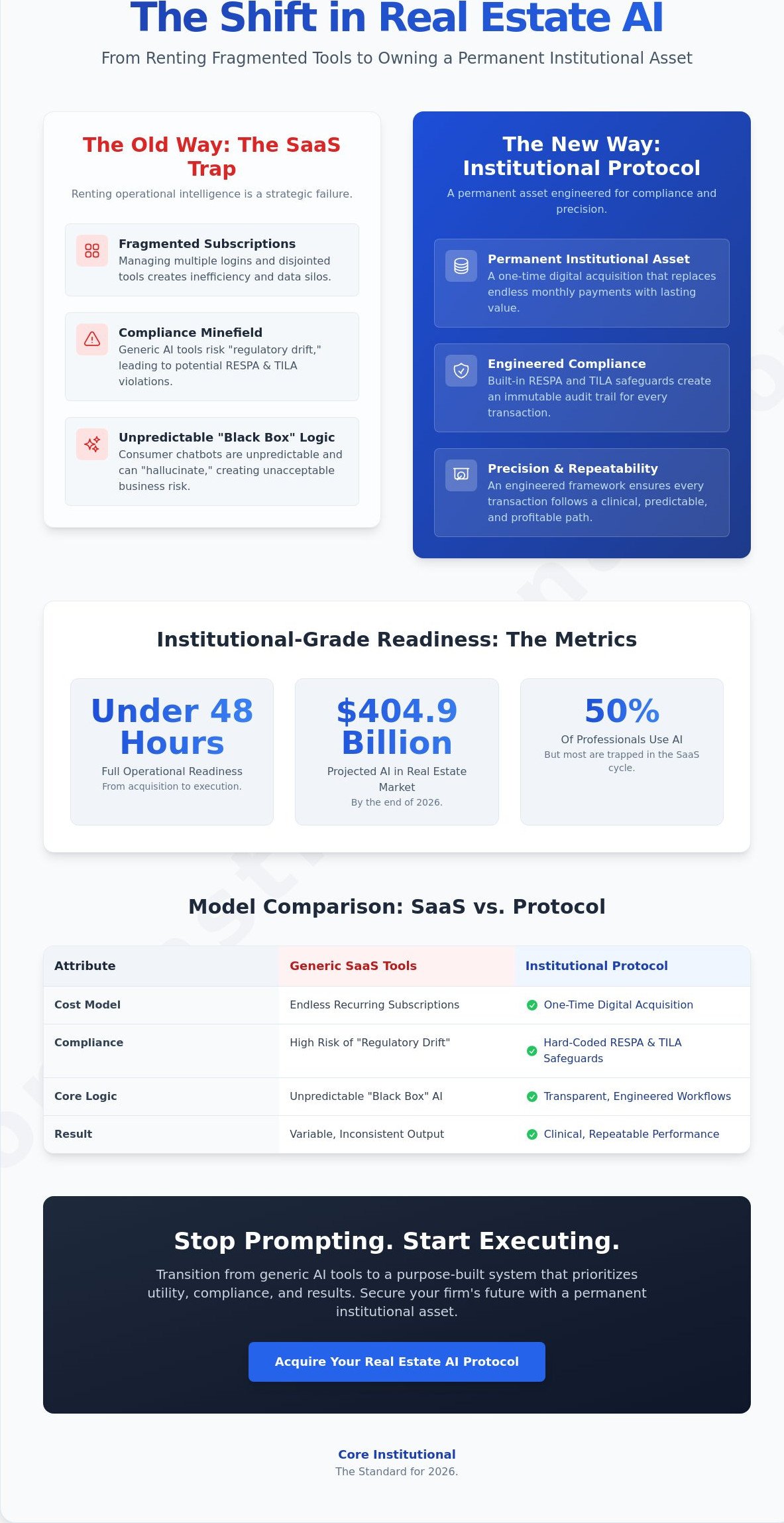
Comparing Real Estate Transaction Management Models
Renting your transaction logic is a strategic liability. Most firms pay monthly for tools they never fully master, contributing to a widening AI productivity gap. A permanent real estate ai workflow protocol shifts the model from a recurring expense to a capital asset. You own the system. You control the data. You eliminate the threat of sudden price hikes or service deactivations. Institutional sovereignty requires that your core operations aren’t dependent on a third-party vendor’s renewal cycle.
Industry analysis from HousingWire confirms that AI in real estate transactions can drive massive efficiency, but only if the professional remains in control of the underlying logic. Relying on SaaS means your business processes are held hostage by external developers. An engineered protocol provides a “one-and-done” philosophy. It functions as a sophisticated piece of machinery rather than a simple digital download. It’s purpose-built to handle the rigor of a market where average commissions sit between 5.44% and 5.70% in 2026.
SaaS vs. Protocol Licensing
Total Cost of Ownership (TCO) analysis reveals the drain of the subscription model. Over a five-year period, SaaS fees for multiple disconnected tools can cost a firm tens of thousands of dollars. Protocols utilize one-time digital product licensing fees. This aligns perfectly with real estate commission cycles. You pay for the asset when the business is liquid, and it continues to perform without further capital outlays. There are no renewals. There is no technical support required because the system is engineered for stability from day one.
Speed to Implementation
Custom software development is a six-month gamble. Most practitioners don’t have the time or the technical staff to manage a build-out. We operate on a 24 to 48-hour benchmark for institutional deployment. This rapid pace reflects our core value: your practice should be operational, not in development. We eliminate the learning curve through pre-configured systems that require no code. You move from a problem state to an operational state almost instantly. This is the standard for serious professionals who value time as their most finite resource.
Key Features of an Institutional Real Estate Protocol
An institutional real estate ai workflow protocol functions as a high-precision engine. It doesn’t just send emails. It manages the complex logic of a multi-party transaction. With Morgan Stanley estimating $34 billion in efficiency gains for the industry by 2030, the difference between a tool and a protocol is the difference between a manual process and a fully operational system. The protocol handles lead prioritization with clinical accuracy. It filters the 82% of Americans using AI for housing market information, identifying high-intent clients while ignoring the noise of casual browsers. Precision leads to higher conversion without increasing your workload.
Scalability is engineered into the system. For growing teams, multi-location management becomes a matter of deployment rather than development. You don’t need a technical team to expand. You simply implement the same proven logic across new branches. This ensures that every office maintains the same institutional standard of service and compliance. It’s a “one-and-done” philosophy that prioritizes your firm’s growth over technical complexity.
Transaction Coordination Automation
The “Closing Loop” is the most high-pressure window in any deal. Errors here lead to rescinded offers and lost revenue. A protocol standardizes the communication between escrow, title, and the lender. It removes the need for manual intervention by automating the status updates and document requests that typically clog an agent’s day. By removing the human element from repetitive coordination, you eliminate the risk of missing a critical deadline. Ready to overhaul your operations? You can acquire the Real Estate AI Protocol and be operational in 48 hours.
Advanced Document Detection
Document fraud is a rising threat in digital transactions. An engineered protocol acts as a first-line defense. It identifies discrepancies in purchase agreements and disclosures automatically. It doesn’t just read text; it verifies data integrity from the initial offer to the final signature. This automated verification ensures that every document in the file matches the institutional standard. It’s a level of rigor that consumer-grade tools can’t provide. This precision-built detection system protects property rights and ensures that every transaction is audit-ready from the moment it begins. You gain security without adding headcount.
Implementing The Real Estate AI Protocol
Fragmentation is the enemy of scale. Most firms currently juggle five or more disconnected subscriptions to manage a single deal. This creates data silos and extreme compliance risks. Transitioning to a single real estate ai workflow protocol eliminates this friction. You’re moving from a state of “rented tools” to owning a permanent institutional asset. It’s an engineered transition. Once implemented, the protocol functions as a cohesive system that manages everything from initial lead capture to final closing disclosures. You stop managing tools and start managing results.
Speed is a core value of the Core Institutional model. We deliver operational readiness in under 48 hours. This isn’t a complex software build or a months-long consulting project. It’s a digital delivery model. You receive the protocol, follow the clinical implementation steps, and begin executing transactions. No technical staff required. No developers needed. You’re securing your practice with a system that respects the June 30, 2026, Colorado AI Act requirements from the moment of activation. It’s fast implementation for proven results.
The Core Institutional Advantage
Our systems require no code and no monthly subscriptions. We’ve done the heavy lifting of engineering compliance into the underlying logic. This rigor was born in the high-stakes medical sector. The same precision used in HIPAA compliant ai workflows for clinical environments informs our real estate protocols. We understand that in regulated industries, “good enough” is a legal liability. You need a system purpose-built for US-based regulations like RESPA and TILA. One-and-done. No renewals. No technical support overhead.
Next Steps for Your Practice
Evaluate your current operational state. Are you currently stuck in a bottleneck of manual document verification? Is your team wasting hours trying to “talk” to generic AI? Moving to an operational state starts with a one-time acquisition. Digital delivery to your inbox is instant. You direct your team toward a standardized, high-performance future where the technology supports the professional. This is the standard for 2026. Stop renting your intelligence. Own your real estate ai workflow protocol and secure your firm’s operational sovereignty today.
Achieve Institutional Operational Readiness
The real estate market in 2026 demands more than just faster emails. It requires a clinical approach to transaction management that eliminates regulatory risk and subscription fatigue. You’ve seen how a real estate ai workflow protocol replaces fragmented tools with a permanent institutional asset. This transition moves your firm from a state of constant technical maintenance to one of total operational readiness. By prioritizing engineered compliance and one-time acquisition, you secure your practice against the volatility of the SaaS market and the strict June 30, 2026, Colorado AI Act deadlines.
Efficiency is no longer optional. With industry gains projected at $34 billion by 2030, the time to implement a purpose-built system is now. You can achieve full deployment in as little as 24 to 48 hours without hiring developers or writing a single line of code. Our protocol is RESPA and TILA compliance-aware from the moment of delivery. Stop renting your business logic and start owning your future. Secure Your License for The Real Estate AI Protocol. Your practice is ready for the shift.
Frequently Asked Questions
Is the Real Estate AI Protocol RESPA compliant?
Yes, the protocol is engineered for strict RESPA and TILA compliance. Unlike generic tools, it uses pre-set logical constraints to prevent prohibited referral fee automation. Every communication is documented; this creates a permanent audit trail that aligns with the CFPB’s Regulation X. This clinical approach ensures your practice remains within legal boundaries while automating high-volume transaction coordination without human error.
How long does it take to implement the protocol in my office?
Implementation is achieved in 24 to 48 hours. We deliver the system as a ready-to-use institutional asset rather than a long-term development project. You don’t need to hire technical staff or wait months for custom software. This rapid deployment reflects our commitment to immediate operational readiness for high-stakes practitioners. You move from a problem state to an operational state almost instantly.
Do I need to pay a monthly subscription fee for this AI system?
No monthly subscriptions or recurring renewals are required. This is a one-time digital acquisition that functions as a permanent business asset. We reject the fragmented SaaS model; this allows you to own your operational intelligence rather than renting it. This structure aligns with real estate commission cycles and eliminates the drain of perpetual software overhead. You pay once for a tool that performs indefinitely.
Can this protocol integrate with my existing real estate CRM?
Yes, the real estate ai workflow protocol is designed for seamless integration with major industry CRMs. It functions as an execution layer that sits on top of your existing data. Because it’s a no-code system, you can connect your lead sources and contact management tools without technical support. This creates a unified institutional workflow that replaces fragmented tools with a single, permanent asset.
What happens if real estate regulations change in 2026?
The protocol’s architecture is built for the specific regulatory climate of 2026, including the Colorado AI Act (SB 24-205). If federal or state laws shift, the system’s modular logic allows for rapid precision adjustments. You maintain total sovereignty over your workflows. This prevents the regulatory drift common in generic consumer-grade AI tools that lack industry-specific guardrails and professional oversight.
Is technical support required to keep the AI protocol operational?
No technical support is required to maintain the system. We’ve engineered the protocol to be a stable, one-and-done solution that operates without constant troubleshooting. It’s a purpose-built piece of machinery designed for professionals who value utility over complexity. Once deployed, the system manages the heavy lifting of transaction coordination autonomously. This eliminates the need for a dedicated IT department or ongoing software maintenance costs.
Can a solo practitioner use the same protocol as a multi-location firm?
Yes, the protocol is engineered for universal scalability. Whether you’re a solo practitioner or managing a multi-location firm, the underlying logic remains consistent. It provides the same institutional-grade precision lead prioritization and document verification across any volume. This allows smaller practices to compete with larger firms by utilizing the same sophisticated transaction management standards without increasing their administrative headcount.
How does this protocol handle secure document processing?
Security is hard-coded into the real estate ai workflow protocol through advanced document detection systems. It identifies discrepancies in contracts and acts as a first-line defense against document fraud. The system ensures data integrity from the initial offer to the final closing signature. This level of rigor protects property rights and ensures every transaction is audit-ready. It’s a sophisticated framework designed for high-stakes professional environments.