
Why are you paying kvCORE up to $1,500 every month for a CRM that functions as a digital graveyard? You already know that manual lead management is a liability. Agents using an automated real estate workflow convert leads at a rate 2.7 times higher than those relying on manual outreach. Yet, most teams remain trapped in a cycle of subscription fatigue and technical complexity. You don’t need another monthly fee or a custom software developer. You need a protocol that works.
This article provides a clinical breakdown of how to transition from fragmented manual processes to an engineered system in under 48 hours. We’ll show you how to eliminate lead leakage and standardize your operations without recurring costs. We’ll examine the specific MOFU checklist items required to achieve operational intelligence. This includes navigating 2026 FinCEN reporting rules and leveraging permanent 100% bonus depreciation under the OBBBA. It’s time to stop managing ideas and start running a purpose-built system.
Key Takeaways
- Define the transition to an automated real estate workflow that replaces manual outreach with engineered triggers.
- Identify the essential MOFU checklist items, including automated lead parsing and the 5-minute engagement protocol for maximum conversion.
- Evaluate the fiscal benefits of one-time licensing compared to the compounding costs of a typical $299/month SaaS subscription stack.
- Follow a clinical 48-hour roadmap to achieve operational readiness with built-in RESPA and TILA compliance.
What is an Automated Real Estate Workflow?
An automated real estate workflow isn’t just a collection of digital tools. It’s a standardized sequence of engineered triggers and actions designed to manage the entire real estate lifecycle. This methodology is a specific application of Business Process Automation. It replaces “manual poking” with an operational system that runs 24/7. In a market where the average 30-year fixed mortgage rate sits at 6.43% as of May 2026, efficiency is the only way to protect your margins. Fast implementation. Proven results.
To better understand how these systems function in a real-world environment, watch this helpful video:
Most CRMs fail because they’re static databases. They hold information, but they don’t move it. A functioning workflow is different. It’s a piece of machinery. While the global real estate software market is projected to reach $57.84 billion by 2034, most agents still use their CRM as a digital graveyard. The 2026 standard requires precision-engineered protocols that handle lead ingestion, compliance, and nurturing without human prompts. It’s the difference between a filing cabinet and an assembly line. You don’t need more data; you need more movement.
The Core Objectives of Real Estate Automation
The primary goal is the elimination of lead leakage. Research shows that agents using an automated real estate workflow convert leads at a rate 2.7 times higher than those relying on manual outreach. This starts with instant engagement. Our protocol ensures a response within 5 minutes, effectively ending the “ghosting” phase that kills most deals. Beyond capture, the system manages transaction coordination. It tracks closing disclosure timelines and HUD paperwork requirements under the 2026 HOTMA rules. Finally, it automates the “Victory Lap” sequence to secure referrals from past clients without manual reminders. It’s professional nurturing on autopilot.
Why ‘Build Your Own’ is a Legacy Strategy
Constructing your own automation logic is a high-risk gamble. The hidden cost of trial and error often exceeds the price of the software itself. You face significant technical debt. When a platform like Lofty or kvCORE updates its API, DIY workflows often break, leading to catastrophic data loss or missed compliance deadlines. This is especially dangerous with new 2026 FinCEN reporting rules for all-cash transactions. The professional alternative is licensing a pre-configured standardized AI protocol. It’s a one-time solution. No custom development. No technical support required. You get an engineered system that is operational in 48 hours.
The Essential Real Estate Workflow Checklist
A high-performance operation requires more than just “following up.” It demands an engineered checklist that eliminates human error at every stage of the funnel. This begins with lead ingestion. Your system must automatically parse inquiries from sources like Zillow and Realtor.com without manual data entry. According to data on Real Estate Prospecting Automation, 2026 agents who leverage these automated funnels see significantly higher retention. Once ingested, the 5-minute response protocol triggers. This is non-negotiable. Speed is the primary determinant of conversion in a market where 30-year fixed rates hover around 6.43%.
Compliance is where most generic systems fail. An automated real estate workflow must be engineered to meet RESPA and TILA standards. As of March 1, 2026, FinCEN requires rigorous reporting for non-financed residential transactions involving LLCs or trusts. There is no minimum price threshold for these rules. If your automation doesn’t account for these regulatory shifts, you’re building on a foundation of liability. Tiered nurture sequences for Hot, Warm, and Cold leads ensure that no prospect is ignored, but they must be compliance-aware to protect your license. For those seeking a tested framework, the Real Estate AI Protocol provides this regulatory-proof structure out of the box.
Pre-Listing and Lead Nurturing Components
Authority is established through precision. Your protocol should include automated CMA delivery triggers that fire the moment a seller lead expresses interest. These aren’t generic emails. They are seller-focused market updates that position you as an expert. For buyers, the system delivers new listing alerts featuring personalized AI commentary. This ensures your outreach feels professional rather than robotic. It’s about maintaining a 24/7 presence without the 24/7 workload. Consistent engagement is the key to managing a digital graveyard.
The Closing and Post-Closing Protocol
The workflow doesn’t end at the contract. Transaction coordination involves automated document collection to ensure every closing disclosure timeline is met. This is critical for HUD compliance under the 2026 HOTMA rules. Post-closing, the system shifts to the “Victory Lap.” This includes automated anniversary check-ins and home value updates. Referral request triggers are timed precisely to the peak of client satisfaction, usually 48 hours after a successful closing. This engineered approach turns a single transaction into a permanent source of revenue. It’s a one-and-done solution for scalable growth.
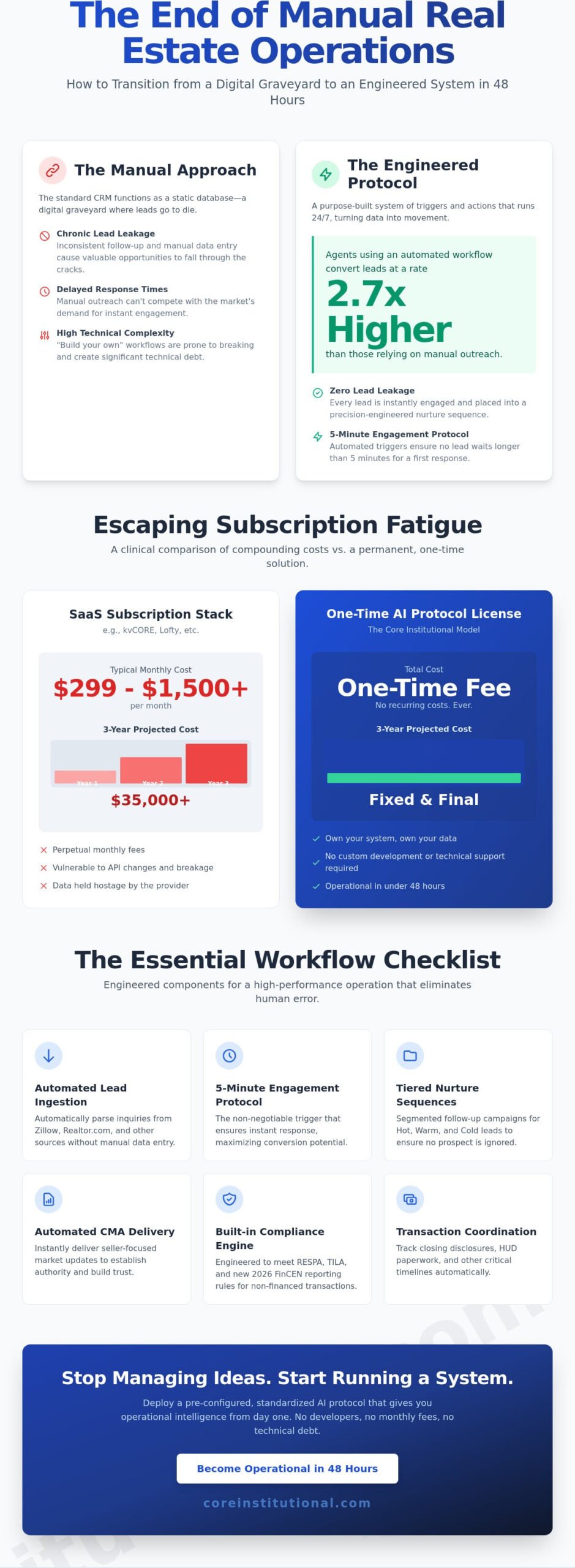
Workflow Models: SaaS Subscriptions vs. One-Time Licensing
Renting your infrastructure is a strategic error. A standard $299 monthly individual agent plan for an automated real estate workflow costs $3,588 annually. Over five years, that is $17,940 spent on a tool you do not own. For teams paying $1,500 monthly for top-tier plans, the five-year cost hits $90,000. These are recurring liabilities that erode your profit margins and create unnecessary overhead. Professional practitioners are shifting to a ‘One-and-Done’ philosophy. They license digital products once and operate them permanently. This move from SaaS to protocol licensing reduces implementation time from weeks of onboarding to just 48 hours of setup. Fast delivery. Immediate operation.
The shift toward ownership is driven by a need for stability. In a market where 15-year fixed mortgage rates are at 5.57% as of May 2026, every dollar of overhead must be justified. SaaS subscriptions are often the first line item to be cut during a downturn because they represent a permanent drain on capital. By contrast, a licensed protocol is an asset. It’s a piece of engineered machinery that stays in your portfolio regardless of market fluctuations. You don’t rent your office furniture; you shouldn’t rent your operational logic.
The Hidden Risks of the SaaS Model
Subscription models create data lock-in. Moving your complex workflows between platforms like kvCORE or Lofty is often impossible without massive data loss or manual rebuilding. You also face price creeping. SaaS providers frequently introduce “minor” monthly increases that compound over time. Finally, there is feature bloat. You end up paying for a suite of complex tools that your team will never use. It’s a bloated stack that prioritizes the provider’s recurring revenue over your operational efficiency. It’s time to stop paying for complexity you don’t need.
The Advantage of Permanent Protocol Licensing
Licensing provides a single upfront investment with zero recurring overhead. There are no renewals and no surprise fees. The protocol is delivered securely to your inbox and lives within your own digital environment. This ensures total control over your business logic. AI sovereignty is the permanent ownership of operational logic. This means your systems don’t break when a third-party developer changes their API or pricing structure. You own the machinery. You control the output. It is the most secure way to scale a high-stakes real estate practice in 2026. Proven results with zero technical debt.
Implementation Checklist: Operational in 48 Hours
Most industry guides suggest a “phased approach” that stretches over several months. This is a legacy mindset that ignores the speed of the 2026 market. You don’t have months to waste on trial and error while the global real estate software market grows at a CAGR of 14.1%. In 2026, the primary competitive advantage is operational intelligence. You can transition from a fragmented manual mess to an automated real estate workflow in exactly 48 hours. This isn’t about building from scratch. It’s about deploying a finished piece of machinery. Fast implementation. Proven results.
Step 1-2: Audit and Acquisition
Start by auditing your current lead sources and CRM data structure. Identify the bottleneck tasks that consume 80% of your production time. For many practitioners, this includes manual data entry from Zillow or checking every all-cash transaction against the March 1, 2026 FinCEN reporting rules. These rules apply to entities like LLCs and trusts regardless of the purchase price. Once you’ve identified these leaks, select a pre-engineered Real Estate AI Protocol. This removes the need for custom software development or expensive technical support. Verify that the protocol is compatible with your existing tech stack. Secure your license. The protocol is delivered instantly to your inbox.
Step 3-4: Deployment and Validation
Deployment is a clinical process, not a creative one. Map the protocol triggers to your primary communication channels. You’ll connect the “logic engine” to your lead sources via secure API or automated parsing. This ensures that every inquiry from Realtor.com or your website initiates the 5-minute response protocol immediately. As of 2026, 92% of CRE companies have moved beyond AI pilots into full operational status. You cannot afford to lag behind. Run a 24-hour stress test on lead ingestion and automated responses. Simulate high-volume scenarios to ensure the logic holds under pressure. If the system parses the data and triggers the correct nurture sequence, you are fully functional. You now own a standardized system that runs 24/7 without recurring fees. It’s a one-and-done solution for serious professionals.
Stop renting your logic and start owning your operations. Get your Real Estate AI Protocol now.
The Real Estate AI Protocol: Engineered for Precision
Generic AI prompts are a liability in a professional environment. They lack the structure required for high-stakes transactions and often produce inconsistent, non-compliant results. The Real Estate AI Protocol is different. It is a piece of digital machinery designed for practitioners who prioritize utility over experimentation. By implementing this automated real estate workflow, you shift from the “solo agent” hustle to an institutional operation. This transition is critical in 2026. With the global real estate software market projected to reach $57.84 billion by 2034, the gap between “manual” and “engineered” businesses is widening rapidly. Fast implementation. Proven results.
The primary advantage of this system is its Compliance-Aware AI framework. Every trigger and response is purpose-built to adhere to RESPA and TILA standards. This isn’t a generic chatbot; it is a regulatory-proof protocol. You don’t need to be a coder or hire a custom software developer. The logic is already mapped. It handles the complex nuances of 2026 reporting requirements, such as the new FinCEN rules for non-financed residential transactions, with clinical accuracy. This allows you to focus on high-level strategy while the protocol manages the operational load. It is a sophisticated tool for serious professionals who do not have time for trial and error.
A One-Time Purchase for Permanent Efficiency
We explicitly reject the modern SaaS model. There are no monthly subscriptions, no renewals, and no hidden fees. When you license the Real Estate AI Protocol, you receive secure digital delivery directly to your professional inbox. This is a one-and-done solution. You own the operational logic permanently. This ownership protects your profit margins from the “price creeping” typical of subscription platforms. It is the last automation system you will ever need to acquire. It is an asset, not an expense.
Next Steps: Becoming Operational
Transformation happens in hours, not months. Review the available Real Estate AI Protocol packages to find the configuration that matches your volume. Our 24-48 hour implementation promise ensures that your practice is overhauled without interrupting your current production. The system is designed for immediate deployment to your existing communication channels. Stop managing a digital graveyard and start running an engineered system. Secure your Real Estate AI Protocol license today and achieve operational readiness before the next market shift.
Achieving Operational Sovereignty
Manual lead management is a structural weakness that your competition will exploit. Transitioning to an automated real estate workflow isn’t just an upgrade; it’s a requirement for surviving the 2026 market. You’ve seen the data. Agents using these engineered systems convert leads at a rate 2.7 times higher than those stuck in manual cycles. By moving away from a $299 monthly SaaS rental and toward protocol ownership, you eliminate recurring liabilities and secure your operational logic. Ownership is the only path to long-term scalability.
The Real Estate AI Protocol is purpose-built for this transition. It’s RESPA and TILA compliance-aware. It handles the March 1, 2026 FinCEN reporting rules for all-cash transactions with clinical precision. There are no renewals, no subscriptions, and no hidden fees. You get a one-time solution delivered directly to your inbox. It’s time to stop managing a digital graveyard and start running an engineered operation. Acquire the Real Estate AI Protocol and become operational in 48 hours. Your practice is ready for its final transformation.
Frequently Asked Questions
What is an automated real estate workflow exactly?
An automated real estate workflow is an engineered sequence of triggers and actions that manage the lead lifecycle without manual interference. It functions as the operational engine of your practice. Unlike a static CRM database, this system moves data through ingestion, engagement, and nurturing phases automatically. It replaces “manual poking” with a 24/7 assembly line for lead conversion.
How much does it cost to automate a real estate business in 2026?
Costs depend on your chosen model. As of May 2026, SaaS subscriptions like kvCORE range from $499 to $1,500 monthly for teams. Individual agent plans on platforms like Lofty start around $299. Licensing a protocol involves a one-time fee, which eliminates the $17,940 five-year overhead associated with traditional rental stacks. Ownership is the most fiscally responsible path.
Is automated lead nurturing compliant with RESPA and TILA?
Yes, but only if the logic is engineered with specific regulatory constraints in mind. Our protocols are purpose-built to meet RESPA and TILA standards. They also incorporate the March 1, 2026 FinCEN reporting requirements for non-financed residential transactions involving LLCs or trusts. High-stakes practitioners require automated real estate workflow systems that prioritize compliance over generic marketing.
Can I implement an AI protocol if I am not tech-savvy?
You don’t need coding skills or technical support. These are “no-code” systems designed for immediate deployment by real estate professionals, not developers. The protocol is delivered with precise instructions for connecting the logic engine to your lead sources. Most users achieve operational readiness in under 48 hours without touching a single line of code. Proven results. Fast implementation.
How fast can I see results from a standardized real estate protocol?
Most practitioners become fully operational within 24 to 48 hours of acquisition. Because the automated real estate workflow is pre-engineered, you bypass the typical months of trial and error. Immediate results include a response time under 5 minutes for 100% of incoming leads. This speed increases conversion rates by 2.7 times compared to manual outreach methods.
Do I still need a CRM if I have an automated real estate workflow?
You still need a database, but the workflow provides the intelligence that makes it functional. The protocol acts as the logic engine that sits on top of your existing CRM. It transforms a “digital graveyard” of stagnant contacts into a high-conversion system. You stop managing data and start managing a functioning piece of machinery.
What happens if I want to change my workflow later?
Licensed protocols are flexible assets that you own permanently. You can adjust the triggers or brand voice mapping within your own digital environment at any time. Unlike SaaS platforms, you aren’t locked into a provider’s rigid feature set. You maintain total control over your business logic without worrying about third-party updates breaking your system.
Is my client data secure with a licensed AI protocol?
Security is significantly higher because the protocol lives within your own environment. You maintain full data sovereignty. You don’t risk the data lock-in or third-party exposure common with multi-tenant SaaS platforms. Your operational logic and client information remain your private intellectual property. It is a secure, institutional-grade solution for serious practitioners.