
Your $20 monthly subscription to GPT-5.5 is likely a liability, not an asset. While 72% of enterprises have adopted AI as of May 2026, most practitioners remain trapped in a cycle of fragmented workflows and generic output quality. You’ve likely felt the subscription fatigue and the mounting pressure of the Colorado AI Act (SB 24-205) taking effect on June 30, 2026. Professional institutional ai systems don’t focus on making you faster at typing prompts; they engineer compliant protocols that eliminate the need for individual prompting entirely.
It’s a common frustration to spend hours “talking” to an AI only to receive a hallucinated response that risks a HIPAA or RESPA violation. You deserve a system that operates with clinical precision. In this comparison, you’ll learn why engineered institutional protocols outperform standard tools and how to implement a permanent solution in under 48 hours. We’ll break down the shift from “prompting” to “protocols” and provide a roadmap for achieving total operational sovereignty without the need for technical support or recurring fees.
Key Takeaways
- Understand why generic chatbots act as “individual motors” that fail without the “assembly line” structure of engineered institutional ai systems.
- Identify the regulatory gaps in consumer-grade AI and how HIPAA-aware protocols protect practitioners from the mounting legal constraints of RESPA and TILA.
- Evaluate the “Build vs. Buy” dilemma to avoid the hidden costs of custom software while maintaining the precision required for high-stakes professional environments.
- Discover how to bypass technical support and six-month consulting cycles with “No Code” systems that move from concept to operational in under 48 hours.
- Transition from the friction of individual prompting to purpose-built workflows that provide permanent sovereignty over your practice’s AI output.
Defining Institutional AI Systems: Beyond the Individual Prompting Trap
Individual productivity is a poor metric for institutional value. While 72% of enterprises have adopted some form of AI as of May 2026, most firms remain stuck in a perpetual research phase. They treat Artificial intelligence (AI) as a bottom-up tool for individual tasks. True institutional ai systems are top-down engineered protocols. They prioritize operational knowledge over fragmented chat sessions. They focus on the output of the practice, not the convenience of the person.
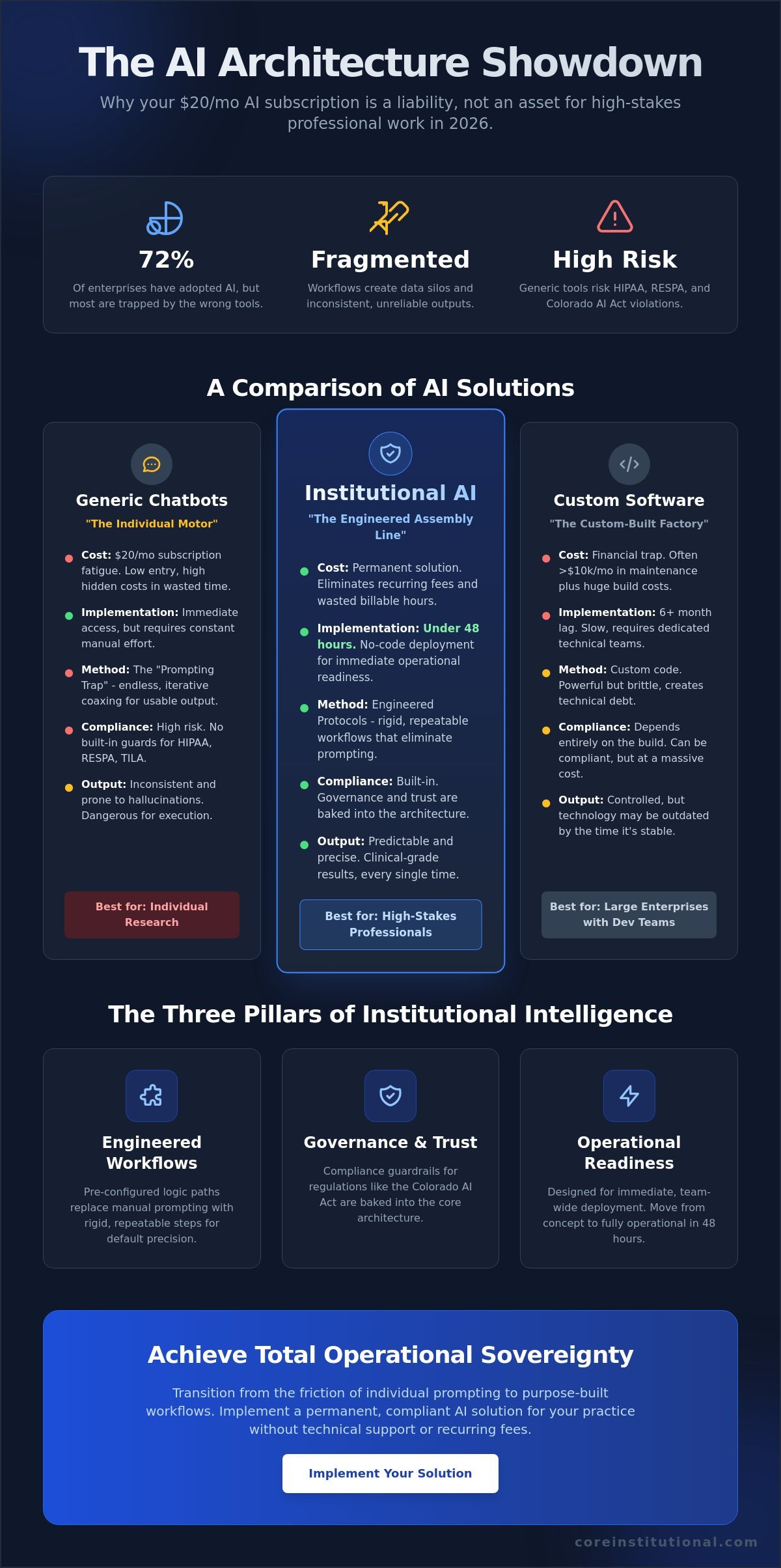
Think of generic AI tools as individual motors. They provide raw power, but a factory needs an assembly line to produce results. Without standardized protocols, you have a pile of motors and no finished product. Institutional systems provide the “assembly line” logic that turns raw AI capability into predictable, professional-grade work. This shift moves your practice from experimental AI activity to a state of operational readiness.
To better understand this concept, watch this helpful video:
The Three Pillars of Institutional Intelligence
- Engineered Workflows: These are pre-configured logic paths. They replace manual prompting with rigid, repeatable steps. Precision is the default setting.
- Governance and Trust: Guardrails are baked into the architecture. This ensures compliance with emerging standards like the Colorado AI Act (SB 24-205) and the EU AI Act.
- Operational Readiness: These systems don’t require six-month consulting cycles. They’re designed for immediate, team-wide deployment. You’re operational in 48 hours.
Why Generic Prompting is a Liability
The hidden cost of “trial and error” is devastating in high-stakes environments. When every staff member “talks” to an AI differently, you create dangerous data silos. There’s no consistency between what a junior associate generates and what a senior partner produces. This fragmentation leads to compliance anxiety and subscription fatigue. It’s a waste of resources that serious firms can’t afford.
The “Prompting Trap” is a systemic drain on professional billable hours where practitioners trade high-value expertise for the low-value task of iterative AI coaxing. Instead of practicing medicine or closing loans, professionals spend 20% of their day trying to get an AI to stop hallucinating. Institutional ai systems eliminate this friction. They preserve context across the entire organization. They ensure that every output meets the same clinical or legal standard, every single time.
Institutional AI vs. Custom Software vs. Generic Chatbots: A Comparison
Professional practices face a critical choice in May 2026. You can rent a generic motor, build a custom factory, or implement an engineered protocol. While 72% of enterprises have adopted AI, most are struggling with the wrong architecture. Choosing the right tier determines whether your practice achieves operational efficiency or becomes buried in technical debt. Effective institutional ai systems bridge the gap between low-grade consumer tools and bloated enterprise software.
Generic chatbots like GPT-5.5 or Gemini 3.1 Pro are accessible for $20 a month. They’re excellent for research but dangerous for execution. They lack the structural integrity required for medical, mortgage, or real estate precision. On the other end, custom software development is a massive undertaking. These projects often suffer from a 6-month implementation lag. By the time the code is stable, the underlying technology has shifted. Institutional protocols are the “Goldilocks” solution. They’re fast, compliant, and pre-engineered for immediate use.
Evaluating the Build vs. Buy Model
The “Build” model is often a financial trap. Custom enterprise solutions frequently exceed $10,000 per month in maintenance and hosting fees. They require dedicated technical support and constant oversight. In contrast, generic AI offers low entry costs but zero compliance. It’s a high-risk gamble with your professional license. Adhering to the NIST AI Risk Management Framework is non-negotiable for high-stakes practitioners. Institutional protocols provide this governance out of the box. You get one-time acquisition with 48-hour deployment. No developers required. No technical support needed. For those seeking immediate operational readiness, exploring engineered AI protocols provides a direct path to sovereignty.
The Problem with AI Subscriptions (SaaS)
Subscription fatigue is more than an annoyance; it’s an erosion of ROI. Monthly fees for tools like Microsoft Copilot or ChatGPT Plus create a “forever-rent” scenario. You don’t own your workflows. You’re leasing them. This model creates fragmented data silos and unpredictable overhead. If the provider changes their terms or prices, your practice is held hostage.
Institutional AI systems prioritize “AI Sovereignty.” This means moving away from the SaaS model toward permanent digital licensing. A “one-and-done” philosophy ensures that your protocols remain your intellectual property. You gain a permanent asset rather than a recurring liability. This is the only way to ensure long-term stability in a market where AI infrastructure spending is projected to reach $176 billion by the end of 2026. Own the system. Don’t rent the results.
The Regulatory Moat: Why Institutional Systems Require Compliance-Aware Protocols
Generic AI is a professional liability. While 72% of enterprises have adopted AI as of May 2026, many are one audit away from a catastrophe. In high-stakes sectors like medicine and mortgage, “secure” isn’t enough. You need systems that understand the law. institutional ai systems provide a regulatory moat by engineering compliance directly into the logic. This prevents the “hallucinations” that lead to legal exposure. It’s about structural integrity. Proven results. No guesswork.
The regulatory landscape is shifting rapidly. The Colorado AI Act (SB 24-205) mandates impact assessments by June 30, 2026. Generic tools don’t provide these assessments. They don’t account for algorithmic discrimination or data transparency. Professional protocols are different. They are built for rigor. They identify document fraud and maintain a clear audit trail. This is the difference between a digital toy and a professional tool. Serious practitioners don’t have time for trial and error.
HIPAA-Aware Engineering for Medical Practices
Basic encryption is a baseline, not a solution. Truly standardized AI protocols go further. They are HIPAA-aware. This means the system logic prevents the storage or transmission of PHI in unsecured environments. It isn’t just about hiding data. It’s about engineering the workflow so privacy violations are impossible. Institutional systems manage patient data with a clinical precision that consumer chatbots cannot replicate. Operational efficiency. Guaranteed compliance.
RESPA and TILA Compliance in Mortgage AI
Mortgage professionals face unique constraints. Automating the Closing Disclosure timeline requires absolute accuracy. A single error in a TILA disclosure can halt a closing. Compliance-aware AI ensures every communication meets strict industry requirements. These protocols are engineered to respect the mandatory three-day review period. They don’t just generate text. They enforce the timeline. This eliminates regulatory friction. It ensures your automated mortgage workflows remain bulletproof. Fast implementation. No technical support required. Permanent AI sovereignty is the only way to protect your practice in a fragmented regulatory environment.
Implementing Institutional AI: From Concept to Operational in 48 Hours
Institutional change is no longer a multi-quarter endurance test. The legacy consulting model suggests a six-month window for system integration. That model is dead. In the current May 2026 market, where global AI spending has reached $2.52 trillion, speed is the primary competitive advantage. institutional ai systems succeed because they bypass the need for custom software development. They arrive as engineered protocols, ready for immediate deployment. No code. No technical support. No delays.
The “No Code” advantage is central to this speed. You don’t need a team of developers to build a proprietary system. You need a pre-engineered logic map that integrates with your existing tools. Secure digital delivery enables a 24 to 48 hour implementation cycle. This isn’t theory. It’s operational reality for high-stakes practitioners who value their billable hours. While a16z.news might argue that factory redesign takes decades, modern digital protocols allow for near-instant redesign. We’ve moved beyond the 1920s timeline.
The 48-Hour Implementation Framework
- Step 1: Protocol Acquisition. You receive secure digital delivery of your system instantly. No waiting for physical hardware or custom builds.
- Step 2: Workflow Integration. You apply the pre-configured logic to your practice. No technical development or coding is required.
- Step 3: Immediate Operational Status. Your entire team begins utilizing the standardized protocols. This ensures consistent professional output across the board.
Achieving AI Sovereignty
The financial case for one-time digital product licensing is undeniable. Monthly SaaS fees for tools like Claude Opus 4.7 or Gemini 3.1 Pro erode your profit margins. They represent a “forever-rent” model that leaves you vulnerable to platform lock-in. If a provider changes their API pricing, which currently sits at roughly $15 per 1 million input tokens for flagship models, your overhead fluctuates. Permanent ownership of your AI workflows turns a recurring expense into a strategic asset.
By choosing a one-and-done philosophy, you eliminate the risk of being held hostage by subscription renewals. You own the protocols. You control the logic. You maintain the sovereignty of your data and your professional standards. To secure your practice’s future, you can implement your engineered protocol today and be fully operational within two days.
The Core Institutional Protocol: Engineered for High-Stakes Professionals
Standardized excellence is not an accident. It’s an engineering outcome. While generic tools are built for the masses, institutional ai systems are engineered specifically for the practitioner. When your stakes involve medical licenses, multi-million dollar closings, or federal audits, “good enough” is a failure state. We provide a clinical, rigorous alternative to the trial-and-error of individual prompting. This is about moving from a state of curiosity to a state of operational dominance. High-stakes professionals don’t need another subscription. They need a permanent system. Proven results. No technical support required.
The transition from fragmented chat sessions to an engineered system is immediate. By locking in professional rigor across your entire organization, you eliminate the variance that leads to compliance errors. Our approach treats AI as a sophisticated piece of machinery. It’s purpose-built. It’s precise. It’s ready to work in 48 hours. You gain total sovereignty over your workflows without the burden of custom software development or recurring fees.
The Medical AI Protocol
Clinical accuracy requires more than a clever prompt. hipaa compliant ai workflows for medical practices are engineered to handle patient documentation and clinical notes with total precision. This protocol manages the complexity of PHI without the risk of data leakage or regulatory friction. It’s built for scale. Solo practitioners use it to reclaim approximately 15 hours of weekly administrative time. Multi-location systems use it to ensure every note meets the same diagnostic standard. HIPAA-aware by design. Operational in two days. Fast implementation is the default.
The Mortgage and Real Estate Protocols
Efficiency in real estate and lending is measured in minutes, not days. The Mortgage AI Protocol streamlines loan officer workflows and lead nurturing while maintaining strict RESPA compliance. It manages the repetitive logic of transaction coordination without the need for human oversight of every minor detail. These systems are not monthly SaaS rentals. They are one-time purchases delivered instantly to your inbox. No technical support needed. No code required. Just immediate results.
Similarly, the Real Estate AI Protocol provides a framework for consistent lead management and document handling. It removes the friction from the sales cycle by automating the “assembly line” of property data and client communication. You gain a permanent digital asset that grows in value as your practice scales. In a market where AI infrastructure spending is hitting $176 billion by the end of 2026, owning your protocol is the only way to ensure long-term stability. Secure your system today. Be operational in 48 hours.
Secure Your Operational Sovereignty Today
The shift from experimental AI to operational dominance is a requirement for survival in May 2026. You’ve seen how generic tools create data silos and how custom software drains capital. True institutional ai systems provide the structural integrity your practice needs. They replace the friction of “trial and error” with pre-configured logic. This ensures that every output meets the rigorous standards of your industry without constant oversight. Permanent ownership of your workflows is no longer a luxury; it’s a strategic necessity.
You don’t need a six-month consulting cycle to transform your practice. Our Medical, Real Estate, and Mortgage AI Protocols are HIPAA and RESPA aware. They’re engineered for immediate team-wide deployment with clinical precision. With a one-time digital licensing fee and no technical support required, you can eliminate subscription fatigue and reclaim your billable hours. The path to a compliant, efficient future is ready for you now. Deploy your Institutional AI Protocol in under 48 hours. Your practice deserves the reliability of a system that’s built to last.
Frequently Asked Questions
What exactly are institutional AI systems?
Institutional ai systems are top-down engineered protocols designed to standardize professional output across an organization. Unlike bottom-up consumer tools, these systems provide a rigid logic framework that eliminates the need for individual prompting. They act as an engineered “assembly line” for knowledge work. This ensures every staff member produces results that meet your practice’s specific clinical or legal standards every time.
Is institutional AI better than hiring a custom software developer?
Yes, because institutional protocols eliminate the 6-month implementation lag typical of custom development. Custom builds often exceed $10,000 per month in maintenance fees and require constant technical oversight. Our protocols offer immediate operational readiness. You bypass the technical debt and focus on your practice. It’s a “Goldilocks” solution providing enterprise-grade rigor without the enterprise-grade headache.
How do these protocols ensure HIPAA or RESPA compliance?
These protocols integrate compliance-aware logic directly into the workflow architecture. For medical practices, this means being HIPAA-aware by preventing the storage of PHI in unsecured environments. For mortgage professionals, it means automating disclosures within the strict timelines mandated by TILA and RESPA. We’ve engineered the guardrails into the institutional ai systems so you don’t have to worry about manual compliance checks.
Can I implement an institutional AI system without a technical team?
You can be fully operational without any technical staff or coding knowledge. These are “No Code” systems delivered as ready-to-use protocols. Implementation involves following a pre-configured guide to integrate the logic into your daily tasks. We’ve done the heavy engineering work. You simply deploy the system and start seeing results in under 48 hours. Secure digital delivery makes the process frictionless.
Why does Core Institutional use a one-time licensing model instead of SaaS?
We prioritize AI Sovereignty and long-term ROI for our clients. Monthly SaaS subscriptions create a “forever-rent” scenario where you never own your workflows. With worldwide AI spending projected to reach $2.52 trillion in 2026, owning your intellectual property is a strategic asset. One-time licensing ensures you have a permanent digital asset with no recurring overhead or platform lock-in. You own the system; you don’t rent the results.
How long does it take for a medical practice to become operational with these protocols?
A medical practice can reach full operational status in approximately 24 to 48 hours. The process is streamlined through secure digital delivery and immediate workflow integration. You don’t need to wait for a 6-month consulting engagement. Our Medical AI Protocol is designed for rapid adoption. This allows solo practitioners and multi-location systems to overhaul their clinical documentation processes over a single weekend.
What happens if the underlying AI models (like GPT-5.5) are updated?
The protocols are engineered to be model-agnostic and compatible with current flagship models like GPT-5.5 and Claude Opus 4.7. When underlying models update, the core protocol logic remains intact. You maintain your standardized workflows while benefiting from the increased processing power of newer iterations. This protects your practice from the volatility of the fast-moving AI infrastructure market while ensuring permanent operational stability.
Are these systems compatible with my existing CRM or EMR?
These systems are designed for seamless integration with professional workflows, including standard CRM and EMR platforms. They function as a layer of intelligence that sits atop your existing data structures. You don’t need to replace your current software. Instead, you enhance it with engineered logic that ensures every piece of client or patient data is handled with precision, rigor, and total compliance.