
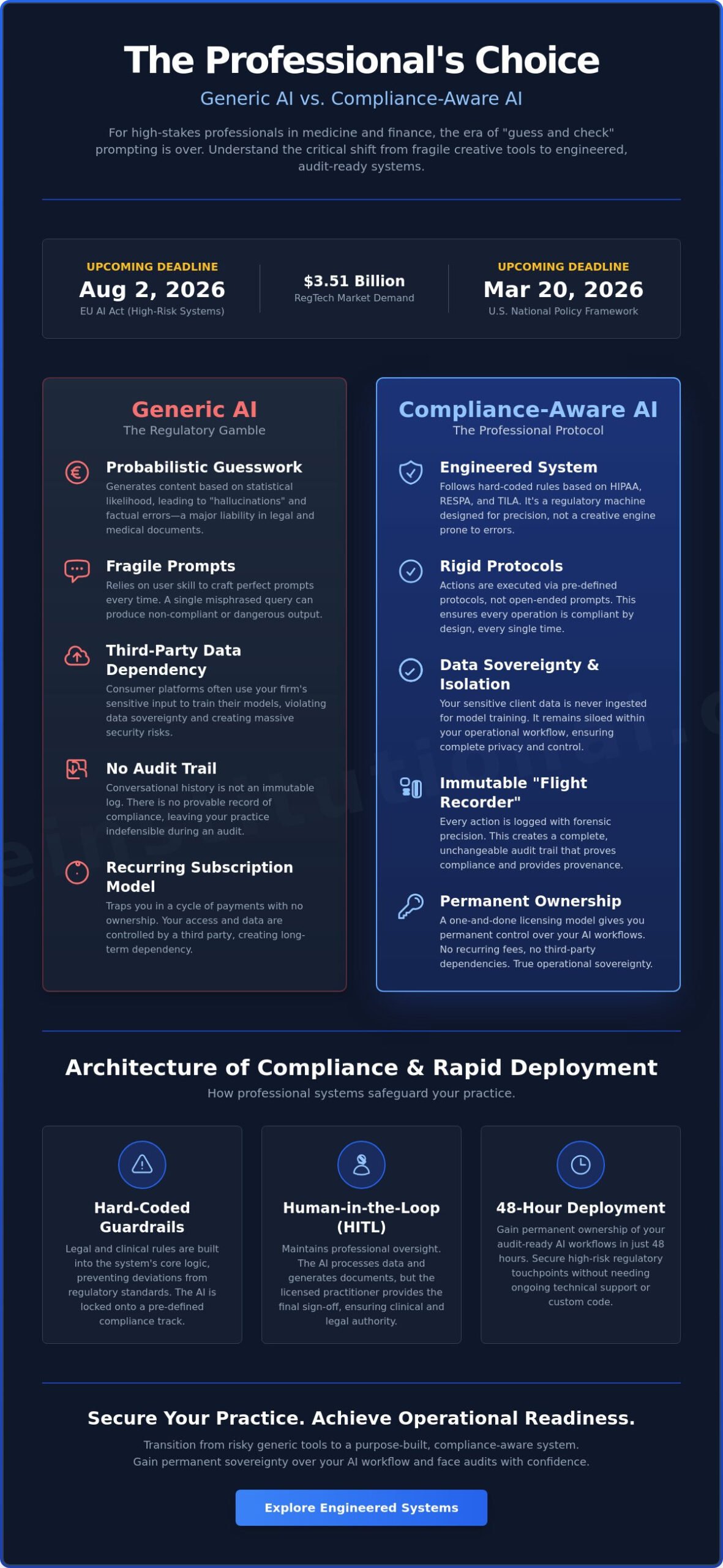
Generic chatbots are a liability for high-stakes professionals. With the EU AI Act high-risk deadline of August 2, 2026 fast approaching and the U.S. National Policy Framework released on March 20, 2026, the era of “guess and check” prompting is over. You’re right to feel anxious about document hallucinations or data sovereignty. Relying on a standard subscription model for your medical or mortgage practice isn’t just risky; it’s a regulatory gamble. Your firm needs precision. Proven results. Fast implementation.
This article demonstrates how a compliance-aware ai protocol safeguards your workflow by baking HIPAA, RESPA, and TILA standards directly into the system architecture. We promise a path to an audit-ready state where you gain permanent ownership of your AI workflows within 48 hours. We’ll examine the engineering behind these protocols and the specific steps to transition from fragile, generic prompts to professional, purpose-built systems. This is how you handle the $3.51 billion RegTech market’s demands with clinical accuracy. No more trial and error. Just operational readiness.
Key Takeaways
- Distinguish between generic creative tools and compliance-aware ai systems engineered for audit-readiness and technical provenance.
- Transition from unpredictable prompts to rigid protocols that act as a “flight recorder” for every professional action within your practice.
- Implement a 48-hour deployment framework to secure high-risk regulatory touchpoints without requiring ongoing technical support or custom coding.
- Secure permanent operational sovereignty through a one-and-done licensing model that eliminates recurring subscriptions and third-party data dependencies.
What is Compliance-Aware AI? Defining the Professional Standard
Standard AI is a creative engine. Compliance-aware AI is a regulatory machine. It refers to systems where specific legal rules are hard-coded into the digital workflow. Unlike generic tools, these systems prioritize audit-readiness and provenance over creative fluency. A compliance-aware ai is an engineered system that produces auditable evidence of regulatory adherence. This level of precision is mandatory for industries governed by HIPAA, RESPA, TILA, and GLBA standards. Precision over flair. Results over conversation.
To better understand this concept and its implications for risk management, watch this helpful video:
The Shift from Generative to Engineered Systems
Generic AI models guess the next word in a sequence. This probabilistic approach creates unacceptable risk for mortgage and medical professionals. Compliance-aware AI follows a strict protocol instead. It’s a structural safeguard. Prompt engineering is a fragile solution because it relies on the user’s ability to ask correctly every single time. It doesn’t provide structural protection. True professional liability protection requires immutable logs. These logs act as a permanent audit trail. They prove what happened, when it happened, and why it complied with the law. They provide the provenance required for the August 2, 2026 EU AI Act deadline. Proven results. No guesswork.
Why Professionals are Moving Away from Generic Chatbots
Practitioners are leaving generic chatbots behind. Consumer platforms often use your input for data training. This practice violates fundamental data sovereignty. Hallucinations in medical or financial documents are more than just mistakes; they’re legal liabilities. In the 2026 landscape, “good enough” is a failure. Systems must mitigate algorithmic bias to comply with the March 20, 2026 National Policy Framework. This requires purpose-built architecture. It requires a system that prioritizes legal constraints over conversational flair. For medical practitioners, HIPAA-aware systems are essential. They don’t just encrypt data; they manage the flow of Protected Health Information (PHI) according to clinical protocols. Real estate and mortgage professionals face similar hurdles with RESPA and TILA. One error in a closing disclosure can trigger massive penalties. Compliance-aware systems prevent these errors by locking the AI into a pre-defined regulatory track. No deviations. No risks.
The Architecture of Compliance: How Protocols Replace Prompts
A flight recorder doesn’t suggest a path; it documents the journey. In a high-stakes professional workflow, compliance-aware ai functions exactly like this. Every decision, every document generated, and every data point accessed is logged with forensic precision. This isn’t a conversation with a chatbot. It’s the execution of an engineered system. Protocols act as the “black box” for your practice, ensuring that if an audit occurs, you have a complete, immutable record of every AI-generated action. This level of transparency is non-negotiable for medical, mortgage, and real estate professionals.
Human-in-the-Loop (HITL) is the cornerstone of this architecture. It ensures that clinical or legal authority remains with the practitioner. The AI processes the data, but the human signs off. This prevents the “black box” problem where decisions are made without oversight. Furthermore, data isolation is a critical safety feature. Professional systems must never “learn” from your sensitive client data. Generic platforms often ingest your inputs to train their next model, creating a massive leak risk. Purpose-built protocols keep your data siloed and sovereign. You own the workflow. You own the data. Permanent sovereignty. For those ready to secure their practice, you can explore our engineered systems today.
Hard-Coded Guardrails vs. Soft Instructions
Generic AI relies on “system prompts” which are essentially soft instructions. The AI can, and often does, deviate from these instructions. A standardized AI protocol is different. It’s a hard-coded guardrail. It restricts the AI’s operational window to industry-specific standards. If a mortgage document requires specific TILA disclosures, the protocol makes it impossible for the AI to omit them. Every output is grounded in verified industry documentation, not the AI’s general training data. This eliminates the risk of hallucinations. It replaces “creative guessing” with “engineered precision.”
The Importance of Provenance and Attribution
Regulators don’t just care about the output; they care about the “why.” Every claim made by your AI must be traceable to a specific source or patient record. This is the essence of provenance. By automating the “Right to Explanation” required by modern AI acts, these systems build immediate trust with regulators. This approach aligns with the NIST AI Risk Management Framework, which emphasizes the need for transparent decision-making logs. Instead of a vague answer, your system provides a documented path from data to decision. This transforms AI from a liability into an asset. Proven results. Audit-ready from day one. You can achieve full operational capacity in as little as 48 hours without the need for a massive development team.
Myth vs. Reality: Why ‘Responsible AI’ Isn’t Enough for Your Practice
A common misconception exists in professional circles. Many practitioners believe that if an AI provider signs a Business Associate Agreement, their firm is automatically protected. This is a myth. Compliance isn’t a software checkbox; it’s a workflow responsibility. A tool can be technically compliant while your usage of it remains a liability. This is the critical gap between “Responsible AI” and compliance-aware ai. One focuses on abstract principles. The other provides the auditable proof required by the August 2, 2026 EU AI Act deadline.
Research into AI-Powered Compliance Workflows highlights that accuracy and ethical safeguards require more than just good intentions. They require engineered rigor. High-stakes professionals often object that AI is a “black box” beyond their control. This anxiety is valid when using generic chatbots. However, institutional protocols remove the mystery. They replace hidden algorithms with visible, hard-coded logic. You don’t just hope the system works; you verify its operation through transparent logs.
The SaaS Vulnerability: Why Subscriptions Risk Compliance
Standard SaaS models present a hidden danger. These platforms update constantly. A silent update on a Tuesday can break a compliance guardrail by Wednesday. Feature creep is another risk. New capabilities often introduce data privacy vulnerabilities without warning. Professional firms require AI sovereignty. This involves:
- Moving away from subscriptions and toward permanent licensing.
- Maintaining a static, “frozen” environment for regulatory stability.
- Eliminating third-party data training on your proprietary inputs.
When you own the protocol, the rules don’t change unless you change them. It’s a “one-and-done” approach to regulatory security. Permanent licensing offers superior AI sovereignty for professional firms that cannot afford the “moving target” of modern software subscriptions.
Beyond Chatbots: Precision Workflows for Medicine and Finance
A chatbot is a toy. It’s designed for conversation, not clinical or financial precision. For a medical practice, a HIPAA compliant AI workflow is a purpose-built tool. It understands the difference between a general query and Protected Health Information. Using generic tools for specialized closing disclosures or patient notes is dangerous. It invites hallucinations into documents that require 100% accuracy. Transitioning from “experimenting with AI” to “operationalizing protocols” is the only way to meet the 2026 regulatory standards. It’s the difference between a hobbyist and a professional architect. This is the core of compliance-aware ai: transforming liability into a structural asset. Provenance matters. Precision wins.
Implementing Compliance-Aware AI: A 48-Hour Professional Framework
Implementation is not a software development project. It’s a deployment of engineered logic. For high-stakes practitioners, the goal is immediate operational readiness. This framework moves your practice from a state of vulnerability to full compliance in under 48 hours. The process is clinical. It’s efficient. It follows five specific steps to ensure your compliance-aware ai is audit-ready from day one.
- Step 1: Identify Regulatory Touchpoints. Pinpoint where HIPAA, RESPA, or TILA regulations intersect with your documentation. These are your high-risk zones.
- Step 2: Deploy Industry-Specific Protocols. Use pre-configured systems built for your field. This eliminates the need for technical support or custom coding.
- Step 3: System Integration. Link your AI-aware documentation directly into existing patient or client management systems. Seamless data flow is the standard.
- Step 4: Establish HITL Review. Implement a Human-in-the-Loop process. Every AI output requires a final clinical or legal sign-off to maintain professional authority.
- Step 5: Secure Sovereign Logs. Store your audit-ready logs in a sovereign digital environment. You own the evidence. You control the access.
This structured approach ensures that no detail is missed. It’s about building a fortress around your workflows. If you’re ready to secure your practice, you can get started with our engineered protocols now.
The 24-48 Hour Operational Window
Standardized protocols bypass the need for custom software development. Most AI projects fail because they take months to build. Our systems are ready for production in under two days. This fast implementation allows you to meet the August 2, 2026 EU AI Act requirements without delay. You achieve Day 1 readiness without a technical background. It’s a one-and-done solution for serious professionals. No code. No renewals. Just operational capacity.
Training Your Team on Compliance-Aware Systems
Team training changes when the system is engineered. You no longer teach staff “prompt engineering.” That’s a waste of time. Instead, you focus on System Oversight. Staff learn to manage the protocol rather than wrestling with the AI. This shift reduces burnout. Automated, compliance-safe documentation handles the heavy lifting. Outputs become standardized across multi-location practices or large brokerage teams. Every patient note and every closing disclosure follows the same rigorous standard. Provenance is maintained. Risk is mitigated. Results are guaranteed.
Institutional AI Protocols: The Sovereign Path to Professional Compliance
Core Institutional provides engineered protocols designed for immediate professional deployment. These aren’t general-purpose chatbots or experimental tools. They are precision instruments. We reject the modern SaaS model. No subscriptions. No renewals. You achieve permanent AI sovereignty through a one-time licensing agreement. This ensures your compliance-aware ai remains static, secure, and entirely under your control. We provide secure digital delivery of workflows that require zero code and zero technical support. Your transition to an operational state happens in hours, not months.
The regulatory deadlines are firm. The EU AI Act obligations for high-risk systems take effect on August 2, 2026. The U.S. National Policy Framework released on March 20, 2026, signals a move toward unified federal oversight. Generic AI can’t keep pace with these shifts. Our purpose-built systems for medical, mortgage, and real estate professionals are engineered to meet these standards today. Proven results. Instant delivery. Total ownership.
The Medical AI Protocol: Precision Patient Documentation
Clinical documentation is a primary source of burnout. The Medical AI Protocol bakes HIPAA-awareness into every clinical note and administrative task. It eliminates the overhead associated with traditional scribes while maintaining 100% auditable accuracy. Every entry is logged. Every decision is traceable. The Medical AI Protocol ensures patient privacy without sacrificing speed by isolating Protected Health Information within a secure, non-training environment. You maintain the clinical authority. The system handles the regulatory rigor. This is the new standard for modern medical practices.
The Mortgage and Real Estate Protocols: Regulatory Rigor
Lead nurturing and transaction coordination must occur within strict RESPA and TILA constraints. Our protocols automate these processes without risking regulatory violations. Specialized document detection protocols secure sensitive financial data automatically. The system identifies social security numbers, bank statements, and tax returns, ensuring they’re handled according to federal privacy mandates. You don’t have time for trial and error. You need a system that works from Day 1. Secure your industry-specific AI protocol today and move your practice into a sovereign, audit-ready state. Fast implementation. Permanent compliance. Professional results.
Achieving Operational Readiness for the 2026 Regulatory Landscape
The transition from experimental AI to compliance-aware ai is no longer optional. With the EU AI Act deadline of August 2, 2026 and the U.S. National Policy Framework released on March 20, 2026, the window for generic tools has closed. You’ve seen how engineered protocols provide the provenance and audit-readiness that standard chatbots cannot. By replacing fragile prompts with hard-coded guardrails, your practice gains structural protection against legal liabilities and data leaks. It’s a shift from “guessing” to “engineering.”
Professional excellence requires permanent sovereignty. Our one-time purchase model eliminates the risks of “feature creep” and silent updates found in standard SaaS subscriptions. You gain HIPAA, RESPA, and TILA aware systems that require zero code and no technical support. This is the sovereign path to professional compliance. Fast implementation. Proven results. No-code deployment means you don’t need a dev team to stay secure.
Become Operational in 48 Hours with Professional AI Protocols
Secure your workflows today. Your practice is ready for the next decade of digital regulation. It’s time to lead with precision.
Frequently Asked Questions
What makes an AI system ‘compliance-aware’ rather than just ‘secure’?
Security focuses on encryption and access control; compliance-awareness focuses on engineered logic and regulatory adherence. A compliance-aware ai system has industry-specific rules hard-coded into its workflow. This prevents the system from generating outputs that violate legal standards like HIPAA or RESPA. Security protects the data, but compliance-awareness protects the professional from legal liability. It’s the difference between a locked door and a guided flight path.
How does compliance-aware AI protect against HIPAA violations in 2026?
These systems isolate Protected Health Information (PHI) within a sovereign environment that never trains on your data. Following the CDC research guidance released on March 12, 2026, our protocols ensure that sensitive patient information is never leaked to third-party models. Every clinical note and administrative task generates an immutable log. This creates a 100% auditable trail for regulatory review. Precision documentation with zero data training risk.
Can compliance-aware AI really be implemented in 48 hours?
Yes. Fast implementation is possible because these are standardized, purpose-built protocols. There’s no custom software development or lengthy coding phase. You deploy the engineered logic directly into your existing patient or client management systems. This “plug-and-play” architecture allows practices to reach an operational, audit-ready state within two days. Proven results without the technical overhead.
Is there a difference between compliance-aware AI for medical vs. mortgage industries?
The underlying regulatory logic is entirely different for each sector. Medical protocols are engineered for HIPAA and clinical accuracy. Mortgage protocols are built to navigate RESPA, TILA, and GLBA constraints. While the compliance-aware ai framework remains consistent, the specific guardrails are purpose-built for the legal requirements of your specific field. Each system is a specialized piece of machinery.
Do I need technical support or coding knowledge to use these protocols?
No technical background or coding knowledge is required. These are “no-code” systems designed for high-stakes practitioners who value their time. You manage the protocol through a professional interface, not a command line. We provide the engineered tools so you don’t have to hire a development team. Instant delivery to your inbox means you’re operational immediately.
What happens if regulatory standards like RESPA or TILA change?
The modular architecture allows for precise logic updates without overhauling your entire workflow. Because you own the license, you maintain operational sovereignty over your system. When federal frameworks shift, like the National Policy Framework update on March 20, 2026, the protocol can be adjusted to meet new benchmarks. You aren’t at the mercy of a SaaS provider’s update schedule. You control the rules.
Why is a one-time license better for compliance than a monthly subscription?
Subscriptions introduce the risk of “silent updates” that can break your compliance guardrails without warning. A one-time license provides a stable, “frozen” environment that you own permanently. This eliminates feature creep and ensures that your audit-ready logs remain private and sovereign. No renewals, no third-party data training, and no recurring fees. It’s a “one-and-done” philosophy for serious professionals.
Does compliance-aware AI replace the need for a compliance officer?
It functions as a force multiplier for your compliance officer, not a replacement. The system automates the tedious work of documentation, attribution, and logging. This allows the officer to focus on high-level strategy and final authority. Our Human-in-the-Loop requirement ensures that a professional always provides the final sign-off. It’s about augmenting human expertise with engineered precision.