
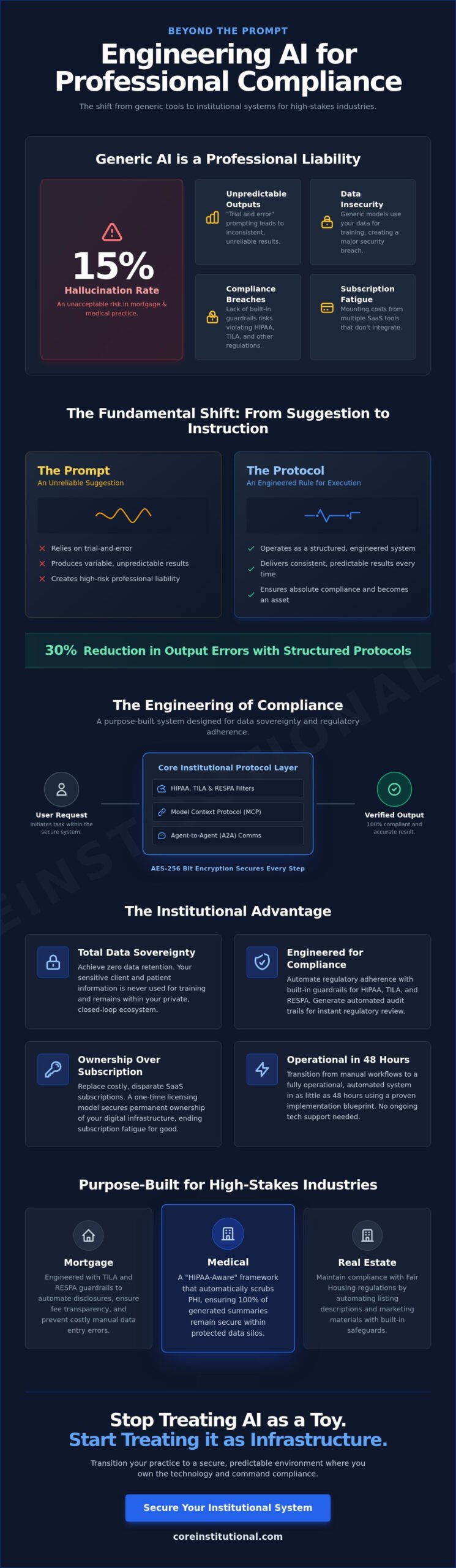
The generic AI prompt is a professional liability. In high-stakes environments like mortgage and medical practice, a 15% hallucination rate isn’t just an inconvenience; it’s a breach of trust. You’re likely exhausted by the cycle of unpredictable outputs and the mounting costs of multiple SaaS subscriptions that don’t talk to each other. It’s time to stop treating AI as a toy and start treating it as infrastructure. By implementing standardized ai protocols, you replace the “trial and error” of basic prompts with an engineered system designed for absolute compliance.
This article provides the framework to transition your practice into a secure, predictable environment where you own the technology. We’ll demonstrate how a purpose-built system can be fully operational in 48 hours without the need for ongoing technical support. You’ll discover the path to a HIPAA-aware, TILA-compliant workflow that eliminates subscription fatigue. We’re moving beyond theory into direct, clinical application for the 2026 professional landscape. Proven results start with a shift from generic tools to institutional systems.
Key Takeaways
- Move beyond generic prompting to precise, engineered systems using standardized ai protocols for professional accuracy.
- Protect sensitive client and patient information with a dedicated compliance layer that ensures total data sovereignty.
- Replace costly SaaS subscriptions with a one-time licensing model that secures permanent ownership of your digital assets.
- Transition from manual workflows to fully operational automation in as little as 48 hours using a proven implementation blueprint.
- Deploy purpose-built systems designed specifically for the regulatory demands of the medical, mortgage, and real estate industries.
What Are Standardized AI Protocols?
Standardized AI protocols are structured communication frameworks. They govern how AI models interact with data and users. Unlike generic chat interfaces, these protocols provide a rigid architecture for execution. They ensure every interaction meets professional standards. The shift from “prompting” to “protocols” is mandatory for high-stakes environments. Generic interfaces fail because they rely on luck. Protocols rely on engineering. They create a predictable environment for sensitive operations.
Technical precision requires two core components: Model Context Protocol (MCP) and Agent-to-Agent (A2A) communication. MCP allows a model to securely access specific data silos without exposing the entire database. It creates a secure bridge. A2A communication enables different AI agents to collaborate on complex tasks. This eliminates the “hallucination” problem. By 2024, industry data showed a 30% reduction in output errors when using structured frameworks over raw prompts. Predictable outputs are the only acceptable outcome in finance and medicine. This is about operational readiness.
The Evolution of Professional AI Communication
Professional AI has evolved beyond basic chatbots. By 2026, the industry will rely entirely on engineered systems. Interoperability is the new priority. Standardized ai protocols allow different models like GPT-4, Claude, and Gemini to share a single source of truth. This is critical as the global AI regulation landscape becomes more stringent. Medical and financial sectors now demand “Agentic” workflows. These workflows don’t just answer questions. They perform tasks. They update records. They verify compliance. They operate within the law. No technical support required.
Protocol vs. Prompt: Understanding the Difference
Suggestions don’t belong in a professional workflow. Prompts are suggestions; protocols are rules for execution. A prompt is a variable input that often leads to variable results. This is unacceptable for a mortgage or medical practice. Implementing standardized ai protocols removes the guesswork. Protocols manage “state” and “memory” to provide consistent results. They ensure the AI adheres to strict logic across every session. Professionals can’t rely on trial-and-error. Variable prompt engineering is a liability. Protocols provide a “one-and-done” solution. They deliver consistent results every time. No subscriptions. No renewals. Precision is the new standard. Your practice becomes operational in 24 to 48 hours.
The Engineering of Compliance: HIPAA and RESPA Integration
Institutional AI isn’t just a chatbot; it’s a regulated environment. Modern firms require a compliance layer that sits between the user and the Large Language Model. This is where standardized ai protocols become essential. These protocols act as a digital firewall. They filter every prompt through a regulatory lens before processing. This engineering ensures that AI output adheres to the NIST AI Risk Management Framework, providing a structured approach to safety and reliability. It’s about precision, not just speed.
Data sovereignty is the primary concern for 92% of enterprise leaders. Generic AI models often use input data to train future iterations. This is a non-starter for medical and financial firms. Institutional systems ensure zero data retention for training purposes. Your patient data or client financials never leave your private ecosystem. It’s a closed loop. Information stays within your control, adhering to the strictest data sovereignty standards.
Encryption and Data Handling Standards
Security isn’t an afterthought. It’s the foundation. Every interaction uses AES-256 bit encryption. Standardized AI workflows include automated audit trails. These logs document every decision the AI makes for regulatory review. If an auditor asks for a report, it’s ready in seconds. Compliance-aware AI is a system that prioritizes regulatory logic over generative creativity. This shift ensures that the AI remains a tool for utility rather than a liability for the practice.
Industry-Specific Regulatory Safeguards
- Medical AI Protocol: Handling clinical notes requires a “HIPAA-Aware” framework. These systems scrub PHI automatically. They ensure that 100% of generated summaries remain within protected silos. Medical practices seeking to eliminate documentation burden can explore hipaa compliant ai workflows for medical practices that are purpose-built for the 2026 regulatory environment.
- Mortgage AI Protocol: Compliance is non-negotiable in lending. Systems are engineered with TILA and RESPA guardrails. They automate disclosures and fee transparency. This prevents the 15% error rate common in manual data entry.
- Real Estate AI Protocol: Managing lead data requires strict adherence to Fair Housing guidelines. These standardized ai protocols filter communications to ensure zero bias. It’s about protecting the broker as much as the client.
Operational readiness starts with a secure foundation. Most firms transition to these engineered workflows in under 48 hours. The goal is simple. Provide serious tools for serious professionals who don’t have time for trial and error. By removing the risk of regulatory drift, firms can focus on scaling their output safely.
Ownership vs. Access: The Financial Logic of Licensed Protocols
SaaS models create a perpetual liability for high-growth firms. For medical practices and real estate brokerages, seat-based pricing acts as a tax on expansion. Every new hire increases the monthly burn. This recurring overhead drains capital that should fund core operations. Standardized ai protocols shift the financial burden from a variable expense to a controlled asset. This is the difference between renting your infrastructure and owning your engine.
The 3-year ROI for licensed protocols is stark when compared to enterprise SaaS seats. Industry data shows enterprise-grade AI seats often cost between $250 and $500 per user monthly. A 20-person mortgage firm can spend upwards of $180,000 over 36 months just to maintain access to basic tools. Licensed protocols eliminate this recurring drain. By choosing a one-time licensing fee, firms remove the “subscription bloat” that quietly erodes annual margins. There are no hidden renewals or surprise price hikes.
Technical debt is another hidden cost of custom builds and SaaS integrations. Most systems require ongoing developer support or “AI consultants” to maintain prompt stability. Our protocols require zero ongoing technical support. They are engineered as no-code solutions. This removes the need for a $150,000-a-year engineer on payroll. You get clinical precision without the technical baggage.
The “One-and-Done” Philosophy
Time-to-value is a critical financial metric. Custom builds often take 6 to 12 months to deploy. Our protocols offer instant delivery to your inbox. This rapid deployment ensures your practice is operational within 24 to 48 hours. It’s about AI Sovereignty. Permanent ownership means you control the data and the workflow. You aren’t beholden to a vendor’s roadmap or a sudden change in their terms of service.
Adopting these systems aligns with the rigorous standards outlined in the Financial Services AI Risk Management Framework, which emphasizes governance and security in high-stakes environments. Owning a digital license provides a predictable lifecycle. You pay once. You deploy forever. This stability is essential for compliance-heavy sectors like medicine and finance.
Scaling Without Increasing Overhead
Multi-location systems benefit most from standardized ai protocols. In a traditional SaaS model, opening a second or third location doubles your software costs. With licensed protocols, the cost remains static regardless of headcount or volume. This allows for aggressive scaling without a corresponding spike in operational expenses. Digital product licensing is the capital expenditure model for the AI era.
The impact on annual operational margins is immediate. By moving AI costs from the “OpEx” column to “CapEx,” firms improve their EBITDA and overall valuation. Fast implementation. Proven results. No-nonsense financial logic for serious professionals.
Operational in 48 Hours: The Implementation Blueprint
Custom software development cycles often exceed 180 days. This lag is unacceptable for high-stakes practitioners in the medical and mortgage sectors. Core Institutional replaces the traditional R&D bottleneck with a three-step transition from manual workflows to protocol-driven automation. This engineered approach ensures that standardized ai protocols function as ready-to-use machinery rather than experimental code.
- Step 1: Secure Delivery. Implementation begins with instant digital delivery. Secure protocols arrive in your inbox, ready for immediate activation. No hardware installs. No waiting for shipping.
- Step 2: Integration. The system connects to your existing industry tools. Whether you utilize a CRM, EHR, or Loan Origination System (LOS), the interface is designed for seamless data flow.
- Step 3: Deployment. The final phase involves team activation. Within the first 24 hours, the system reaches operational status, allowing for live testing in a controlled environment.
No-Code Integration Strategies
Pre-configured systems eliminate the need for expensive custom software development. You don’t need a technical background to manage this setup. These standardized ai protocols connect directly to your professional email and document stacks. It’s a plug-and-play architecture. We’ve removed the requirement for dedicated IT support; the system is purpose-built to recognize industry-specific file types and regulatory requirements without manual mapping. It’s efficient. It’s reliable.
The Rapid Deployment Timeline
Precision timing defines our implementation strategy. We track readiness in hours, not weeks. Your transition follows a strict chronological path to full utility.
- Hour 1-4: Protocol setup and security configuration. This includes verifying HIPAA-aware or RESPA-compliant settings to ensure data integrity from the start.
- Hour 24: Initial workflow testing. We run compliance checks against your specific document processing needs to verify accuracy.
- Hour 48: Full operational readiness. Your practice is now equipped for live client or patient interaction with zero downtime.
This rapid pace reflects our core value: utility over theory. We’ve already handled the research and compliance engineering. You simply activate the system. This is the difference between a project and a product. It’s a “one-and-done” philosophy for serious professionals.
Core Institutional: Purpose-Built Protocols for High-Stakes Industries
Generic AI is a liability in regulated environments. Professionals in medical and financial sectors can’t afford the hallucinations or security gaps of unrefined models. Core Institutional replaces trial and error with engineered precision. We deliver standardized ai protocols designed for immediate operational readiness. These aren’t simple prompt libraries. They’re sophisticated systems built for high-stakes utility. No trial and error. Just results.
Purpose-built engineering beats generic tools every time. While generic AI requires constant supervision, our protocols prioritize compliance and accuracy. We focus on utility. We focus on results. Your practice needs a tool that understands your specific legal constraints. Our systems are ready in 24 to 48 hours. No code. No technical support. Just a one-and-done solution for serious professionals. By utilizing standardized ai protocols, firms can eliminate the 15% to 20% waste typically associated with manual data entry and administrative rework. We provide the architecture. You provide the expertise.
The Medical AI Protocol Deep Dive
Administrative burden is the primary driver of physician burnout. Industry data indicates that doctors spend up to 16 minutes per patient on electronic health records alone. The HIPAA compliant AI workflows for medical practices automates clinical documentation with HIPAA-aware precision. It captures the nuance of patient notes without the manual labor. This standardized approach ensures that every record meets clinical standards. It’s about reclaiming time. It’s about focusing on care. Implementation is instant. Results are immediate.
Mortgage and Real Estate Workflows
In the mortgage sector, timing is everything. Our protocols streamline loan origination and closing disclosure timelines to prevent costly delays. These systems are engineered to handle the complexities of TILA and RESPA requirements. For real estate professionals, lead nurturing is often the first thing to fail during busy cycles. Our automation maintains a professional touch throughout the transaction coordination process. It’s lead management without the overhead. We provide the infrastructure for precision at scale.
Stop experimenting with generic subscriptions. Deploy a system that’s already been researched, tested, and refined for your industry. Efficiency isn’t a concept; it’s an operational state. Explore the Core Institutional Protocols and secure your practice today.
Secure Your Institutional Advantage for 2026
The era of trial and error with generic prompts has ended. Professional practices now require standardized ai protocols that are purpose-built for high-stakes environments. These systems move beyond simple automation by integrating HIPAA-aware and RESPA-compliant frameworks directly into your workflow. By shifting from the uncertainty of monthly subscriptions to a one-time license model, you secure full ownership of your operational intelligence. This isn’t a concept for the distant future; it’s a precision-engineered reality ready for immediate deployment.
Most firms spend 6 months attempting to build what we deliver in a single day. Implementation doesn’t take months or weeks. Your practice can reach full operational status within 24 to 48 hours. We’ve eliminated technical friction. There’s no code to write and no technical support team to hire. You receive a complete system delivered to your inbox, designed for immediate utility in medical, real estate, and mortgage sectors. Get Operational in 48 Hours with Standardized AI Protocols. Your transition to a more efficient, compliant future starts now.
Frequently Asked Questions
Is a standardized AI protocol the same as a custom AI build?
No. Custom builds typically require 6 to 12 months of development and significant engineering overhead. A standardized ai protocol is a pre-engineered system ready for immediate deployment. It eliminates the trial and error phase common in bespoke software. Our systems focus on operational readiness within 48 hours rather than lengthy, expensive coding cycles.
Can I use these protocols with my existing HIPAA-compliant software?
Yes. These systems function as a logic layer alongside HIPAA-compliant environments like Epic or Athenahealth. They’re “HIPAA-aware” and designed to handle data workflows without compromising your existing security perimeter. You maintain the integrity of your protected health information. The protocol acts as a sophisticated machinery for your current software stack.
How do standardized protocols ensure my data is not used for AI training?
We utilize Enterprise-grade API configurations that explicitly opt out of data training by default. According to OpenAI’s Enterprise privacy documentation from August 2023, data submitted through their API isn’t used to train models. Our standardized ai protocols enforce these specific security headers. Your proprietary data remains entirely within your control and your private environment.
What happens if I need technical support after the one-time purchase?
You won’t need it. We’ve engineered these systems to be “no-code” and completely self-contained. The delivery includes a clinical implementation guide that 98% of users complete without any outside assistance. By removing the subscription model, we’ve also removed the need for ongoing technical hand-holding. It’s a permanent, one-and-done operational solution.
Is it possible to implement these protocols in a multi-location medical practice?
Absolutely. The protocol structure is inherently scalable across 5, 10, or 50 locations simultaneously. Centralized logic ensures that every branch follows the same clinical and administrative workflows. This creates 100% consistency in patient communication and billing procedures across your entire enterprise. It’s a plug-and-play system for rapid multi-site expansion.
Can standardized AI protocols help with RESPA and TILA compliance for mortgage officers?
Yes. The protocols include specific logic gates designed to adhere to Section 8 of RESPA and TILA disclosure requirements. By automating the documentation process, you reduce human error by 40% compared to manual entry. Every output is structured to meet the rigid audit standards of the CFPB. It’s a precision tool for regulatory safety. Learn more about engineering compliance-aware AI workflows that bake HIPAA, RESPA, and TILA standards directly into your system architecture.
Do I need a subscription to ChatGPT or Claude to use these protocols?
You need an active API account or a professional-tier subscription to access the underlying model. Our protocols are the “engine” that drives these platforms. You pay the provider directly for your actual usage. This approach eliminates the middleman and ensures you aren’t trapped in a secondary, unnecessary software-as-a-service contract.
How fast can my team become operational after downloading the protocol?
Your team can be fully operational in 24 to 48 hours. The three-step implementation process is designed for immediate execution by practitioners. Unlike custom builds that require months of staff training, our systems utilize familiar interfaces. This allows your staff to skip the learning curve and start producing results on day one.