
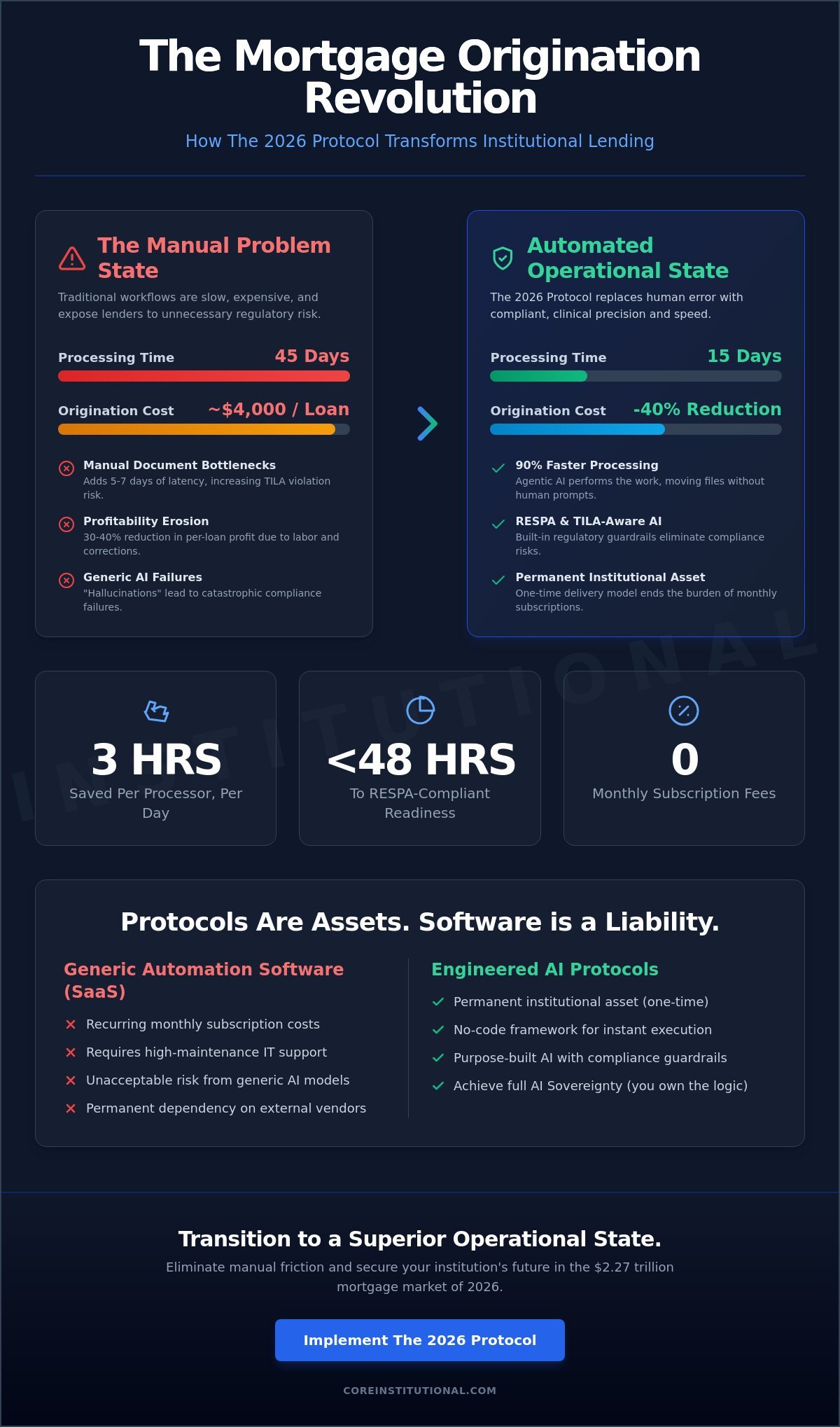
Lenders utilizing AI-driven models have documented a 90% increase in processing speed, reducing traditional 45-day cycles to just 15 days as of May 2026. With mortgage origination volume projected to reach $2.27 trillion this year, the margin for operational error has vanished. You’re likely struggling with origination fees that climb toward $4,000 per loan and the constant risk of TILA violations caused by manual document bottlenecks. High-stakes mortgage loan origination workflow automation is no longer a luxury; it’s a regulatory requirement for institutional survival.
We understand that generic AI prompts and expensive SaaS subscriptions don’t solve the core problem of operational efficiency. You need precision. This guide details how to implement a permanent, non-subscription solution that achieves RESPA-compliant readiness in under 48 hours. We’ll examine the specific engineered protocols that reduce per-loan processing costs by 40% and save your processors 3 hours every single day. The 2026 Protocol is here. It’s time to transition from a manual problem state to an automated operational state.
Key Takeaways
- Identify manual friction points in your current documentation process and replace them with an engineered system of protocols.
- Discover how RESPA and TILA-aware AI provides built-in regulatory guardrails to eliminate the risks associated with generic prompts.
- Implement mortgage loan origination workflow automation as a precision protocol rather than a high-maintenance software package.
- Transition from a manual state to full operational readiness in 48 hours using a proven no-code implementation strategy.
- Secure a permanent institutional asset with a one-and-done delivery model that removes the burden of monthly subscriptions.
The Inefficiency of Traditional Mortgage Loan Origination Workflows
Traditional lending systems are no longer sufficient for the $2.27 trillion market of 2026. We define mortgage loan origination workflow automation as an engineered system of protocols designed to replace human error with clinical precision. These systems aren’t just software downloads. They’re clinical architectures. An engineered protocol ensures that every data point is cross-referenced against 2026 QM thresholds and HOEPA limits automatically. This eliminates the “trial and error” phase of loan processing. Unlike legacy software, these protocols function as an autonomous architecture. They manage the mortgage origination process from initial application to final funding without the friction of manual intervention.
The manual friction point is most evident during the document verification phase. This is where documentation slows down the closing disclosure timeline, often adding five to seven days of unnecessary latency. In 2026, institutions still relying on manual entry see a 30% to 40% reduction in per-loan profitability due to labor costs and correction cycles. While average 30-year fixed rates sit at 6.37%, lenders can’t afford to lose thousands in origination fees to administrative sludge. Legacy CRM “automation” is a misnomer; it simply triggers notifications. Modern, agentic AI protocols actually perform the work, moving files from stage to stage without human prompts.
To better understand the shift toward agentic systems, watch this technical overview:
The High Cost of Manual Documentation
Manual data entry remains the primary bottleneck in loan origination. When a processor manually transcribes data from a W-2 or bank statement, the risk of a TILA violation increases. Compounding delays occur when missing or incorrect borrower information isn’t identified until the underwriting stage. This creates a feedback loop that destroys operational efficiency. One error in a debt-to-income ratio calculation can force a complete restart of the disclosure period. Every human intervention increases the financial burden on the firm. The cost per touch in a manual origination environment is a direct measurement of institutional waste and a primary driver of the $4,000 per-loan overhead seen in 2026.
Why Generic AI Fails the Mortgage Industry
Generic AI models are dangerous in a regulated environment. They’re prone to “hallucinations” during complex income calculations or asset verifications. These errors lead to catastrophic compliance failures. A standard chatbot can’t handle the rigor of professional mortgage workflows. It lacks built-in regulatory guardrails. Non-specific AI also fails to maintain a transparent, immutable audit trail. For 2026 lenders, using generic prompts is an unacceptable risk. Only purpose-built protocols provide the security required for high-stakes lending. They ensure every decision is backed by data and compliant with the latest Regulation Z asset-size exemption thresholds.
Engineered Protocols vs. Generic Automation Software
Software is a liability. Protocols are assets. Most lenders equate mortgage loan origination workflow automation with complex software platforms that require internal IT teams and endless updates. This is a strategic error. Software must be maintained; protocols are simply executed. Our engineered approach prioritizes operational readiness over technical complexity. A no-code framework ensures that your team remains focused on funding loans rather than troubleshooting code. If a system requires ongoing technical support, it’s fundamentally weak. Institutional-grade AI relies on standardized frameworks that work instantly. This isn’t a custom build. It’s a precision instrument. We prioritize AI Sovereignty. This means you own the logic. Permanent licensing replaces the dependency on external vendors. It’s a one-and-done transition to a superior operational state.
The Limitations of SaaS in Mortgage Lending
SaaS models are designed for the vendor’s profit, not the lender’s efficiency. Monthly subscriptions and per-user fees create a variable cost structure that erodes your margin. For a $400,000 mortgage, origination fees already range from $2,000 to $4,000 as of May 2026. Adding a perpetual software tax is counterproductive. This is why standardized AI protocols provide a superior long-term ROI. They eliminate the risk of vendor lock-in. Cloud-based platforms can change their terms or pricing at any time. A local, engineered protocol ensures your compliance with the Real Estate Settlement Procedures Act remains under your direct control. You shouldn’t rent your infrastructure. You should own it.
Precision-Engineered Workflows
A purpose-built mortgage AI protocol is an architectural masterpiece. It uses standardized inputs to generate consistent, audit-ready outputs. This precision engineering reduces “loan officer fatigue” by automating the repetitive data verification tasks that lead to burnout. In 2026, 72% of brokers expect AI usage to grow significantly. Most will fail because they choose generic tools. Our protocols ensure every loan file meets the specific HOEPA and QM thresholds automatically. This results in faster turn times and reduced overhead. It’s time to stop managing software and start executing results. Explore the Mortgage AI Protocol to secure your operational future. This transition takes less than 48 hours. No trial and error. Just results.
Solving the Compliance Barrier: RESPA and TILA-Aware AI
The primary objection to mortgage loan origination workflow automation is regulatory risk. Practitioners often ask: “Is AI compliant with federal regulations?” The answer depends on the architecture. Generic AI models are a liability because they lack context. Compliance-aware AI is different. It’s an engineered system with built-in regulatory guardrails. These protocols don’t just process data; they enforce law. By hardcoding federal requirements into the workflow, you eliminate the variance of human judgment. This ensures that every file remains within the strict parameters of the 2026 QM thresholds and TRID rules. Precision is the only path to safety.
Our protocols manage the closing disclosure timeline automatically. This removes the possibility of a “forgotten” disclosure or a late delivery. In 2026, the regulatory environment is increasingly unforgiving. An executive order has already prompted tighter scrutiny of TRID rule adherence for community banks. To survive an audit, you need a permanent, unalterable audit trail. Our systems record every decision, data extraction, and communication in real time. This creates an immutable record of compliance that no manual spreadsheet can match. It’s institutional-grade security for serious professionals.
RESPA Compliance in Automated Communications
Protocols prevent prohibited kickbacks and unearned fees through standardized tracking. Every referral and service provider interaction is logged against RESPA standards. This ensures all borrower disclosures are delivered within the mandatory three-day window. There’s no room for delay. AI protocols automate the verification of RESPA standards by cross-referencing service provider fees against the initial Loan Estimate. This prevents “fee bloat” and ensures that the final Closing Disclosure remains within the allowable tolerances. It’s a clinical approach to fee management.
TILA and the Ability-to-Repay (ATR) Rule
AI ensures consistent application of ATR standards across all files. It doesn’t get tired or overlook a debt-to-income ratio spike. These protocols handle complex income scenarios, including self-employed borrowers and rental income, without manual recalculation. This is critical as the Regulation Z asset-size exemption threshold has increased to $2.785 billion in 2026. Algorithmic consistency also reduces the risk of “fair lending” violations. By removing subjective human bias from the initial data analysis, you ensure that every applicant is evaluated solely on their financial merit. This aligns perfectly with the ECOA update effective July 21, 2026, which focuses on intentional acts of discrimination. Proven results. Absolute compliance.
Achieving Operational Readiness in 48 Hours
Traditional digital transformation is an institutional trap. It relies on a six-month SaaS rollout that drains resources and focus. In contrast, our engineered protocols achieve full operational readiness in under 48 hours. This isn’t a theory. It’s a proven deployment framework. We define mortgage loan origination workflow automation as a plug-and-play architecture that eliminates the need for custom development. If your system requires ongoing technical support, it’s a sign of a weak, unrefined product. Serious professionals don’t have time for support tickets. They need systems that work on day one.
The process follows a clinical three-step sequence. Step 1 is secure digital delivery. You receive the Mortgage AI Protocol instantly in your inbox. Step 2 is the integration of pre-configured workflows. These protocols are designed to interface with your existing stack without disrupting current operations. Step 3 is immediate execution. Your team begins processing compliant loan files within hours, not months. This rapid transition is essential in a market where 55% of mortgage brokers already report daily AI usage as of May 2026. Speed is the only metric that matters.
The 24-48 Hour Implementation Framework
Instant digital delivery is the cornerstone of our model. We bypass the IT bottleneck by providing pre-engineered protocols that don’t require server-side modifications. Your team adoption happens almost immediately because the system mirrors the logic of a seasoned processor. Setting expectations is simple. Within the first 24 hours, the system is installed. By 48 hours, your initial output will show a 90% increase in processing speed compared to manual methods. It’s a fast, efficient overhaul of your entire operation.
Removing Implementation Friction
Generic prompts are the enemy of fast implementation. They require constant “hand-holding” and refinement that mortgage professionals can’t afford. Purpose-built systems eliminate the learning curve by providing a standardized framework from the start. There’s no trial and error. The Operational State for a mortgage practice is defined as the point where the institution transitions from manual document chasing to autonomous, protocol-driven funding. This state is achieved the moment the protocol is executed. To secure this transition for your firm, acquire the Mortgage AI Protocol and eliminate manual bottlenecks today. Results are immediate. Implementation is final.
The Mortgage AI Protocol: Institutional-Grade Automation
The Mortgage AI Protocol represents the definitive operational standard for 2026. We’ve engineered this system to serve as the final solution for practitioners who demand precision without the burden of perpetual software management. This is not a platform you rent. It’s an asset you own. By implementing mortgage loan origination workflow automation through a purpose-built protocol, you secure your firm against the volatility of the $2.27 trillion origination market. Our “One-and-Done” philosophy is a direct rejection of the modern SaaS model. There are no renewals. There are no surprise price hikes. Once the protocol is delivered to your inbox, it’s yours to execute. This clinical approach provides a level of stability that subscription-based competitors cannot match. It’s the difference between a temporary fix and a permanent operational overhaul.
Scalability is hardcoded into the architecture. Whether you’re a solo broker or a multi-location firm, the protocol adapts to your volume without requiring additional technical support. It handles the rigorous RESPA and TILA-aware compliance frameworks mentioned earlier with absolute consistency. In a year where 72% of brokers expect AI usage to grow significantly, having a standardized framework is your primary competitive advantage. You don’t need a team of developers to scale. You simply need a system that doesn’t break under pressure. The Mortgage AI Protocol is that system. It’s engineered for high-stakes lending where error isn’t an option.
The Economic Case for Protocol Licensing
The financial logic of protocol licensing is undeniable. Compare the lifetime value of a one-time license to a standard 5-year SaaS contract. Subscription models extract value indefinitely, often costing institutions 300% more over a five-year period than a single-acquisition protocol. Owning your AI workflows turns an operational expense into a permanent institutional asset. You eliminate the per-user fees that penalize your growth. This model supports the 40% reduction in per-loan processing costs documented by top-tier lenders this year. To begin your transition, you can request the Mortgage AI Protocol for immediate digital delivery. It’s the most efficient path to long-term profitability in 2026.
Final Operational Checklist
Your transformation from a manual problem state to a protocol-driven operational state is now complete. Before execution, confirm your system readiness against this final checklist:
- Protocol Verification: Ensure the Mortgage AI Protocol is integrated into your primary document flow.
- Regulatory Alignment: Confirm all workflows are set to the May 2026 QM and HOEPA thresholds.
- Audit Trail: Verify that the automated, unalterable log is active for every loan file.
- Team Readiness: Confirm your processors are prepared for the 3-hour daily time savings.
The 2026 regulatory environment requires more than just “good intentions.” It requires engineered certainty. Transition to institutional-grade automation today. Eliminate the bottlenecks. Secure your margins. Results are immediate. Implementation is final.
Secure Your Institutional Future
The shift toward mortgage loan origination workflow automation is no longer a strategic option; it’s an operational necessity for the 2026 lending environment. We’ve established that legacy software and generic AI prompts fail to meet the rigorous demands of RESPA and TILA compliance. Engineered protocols provide the only path to a 40% reduction in per-loan processing costs while ensuring absolute regulatory precision. By moving from a manual state to a protocol-driven state, you reclaim 3 hours of productivity per processor every single day. This is a permanent transition to institutional-grade efficiency. You don’t have time for trial and error.
Stop renting your infrastructure. Own your logic. Get the Mortgage AI Protocol and become operational in 48 hours. Our systems are purpose-built for the high-stakes professional. There are no subscriptions and no renewals. Just clinical results delivered to your inbox in under 48 hours. Achieve RESPA-compliant operational readiness and secure your margins in the $2.27 trillion market of 2026. Your transition begins now.
Frequently Asked Questions
Is mortgage loan origination workflow automation RESPA compliant?
Yes, mortgage loan origination workflow automation is RESPA compliant when built as a clinical protocol rather than a generic prompt. Our system includes automated tracking for the three-day disclosure window and monitors fee tolerances with 100% precision. It ensures every referral and service provider interaction follows the specific 2026 TRID rule amendments. This eliminates the risk of prohibited kickbacks by standardizing every communication channel.
How long does it take to implement an AI mortgage protocol?
Implementation takes between 24 and 48 hours to reach full operational readiness. Unlike traditional SaaS rollouts that require six months of training, our protocols are delivered as pre-engineered systems. You bypass the IT bottleneck entirely. Within two days, your team can begin processing files with a 90% increase in speed. Fast implementation. Immediate results.
Can I use AI for mortgage origination without a SaaS subscription?
You can use AI without a SaaS subscription by opting for permanent protocol licensing. We reject the monthly renewal model in favor of a one-and-done philosophy. You own the logic and the workflow. This removes the variable cost of per-user fees and protects your firm from vendor lock-in. It’s a permanent institutional asset.
What is the difference between generic AI and a purpose-built mortgage protocol?
Generic AI is prone to hallucinations in income calculation, while purpose-built protocols are engineered for mathematical precision. Standard chatbots lack the regulatory guardrails required for high-stakes lending. The Mortgage AI Protocol uses standardized frameworks that don’t require custom builds. It’s a sophisticated piece of machinery designed for the specific legal constraints of the mortgage sector.
Do I need technical skills to use the Mortgage AI Protocol?
No technical skills or support teams are required to execute the protocol. The system is fundamentally a no-code solution designed for practitioners, not developers. If a system requires technical support, it’s a sign of a weak system. Our protocols are purpose-built to be intuitive and ready for immediate deployment upon digital delivery.
How does AI automation improve the closing disclosure timeline?
AI automation improves the closing disclosure timeline by removing manual document bottlenecks. Processes that took 45 days in 2022 now take just 15 to 25 days in 2026. This speed is achieved through automated data extraction and real-time verification. Implementing mortgage loan origination workflow automation ensures the closing disclosure is accurate and delivered on time, every time.
Can AI protocols handle multi-location mortgage systems?
AI protocols are designed with a scalable architecture that handles multi-location firms as easily as solo practices. The logic remains consistent across all branches, ensuring uniform compliance and operational standards. This prevents compliance drift where different locations apply rules differently. It’s a centralized solution for decentralized teams that values your time.
What happens if regulations change after I purchase the protocol?
Protocols are modular, allowing for rapid adjustment if federal regulations change. Because you own the system, you aren’t waiting for a SaaS vendor to update their global code. You can refine logic locally to match new ECOA updates or the $2.785 billion Regulation Z threshold. This provides long-term operational security in a dynamic regulatory environment.